 Now Serving Canada
Cal/OSHA's Changing Fall Protection Requirements: 2026 Guide
Editor’s note: This article was written in June 2026 and is subject to updates.
Cal/OSHA’s fall protection requirements have been significantly updated since January 2025. Beginning on July 1, 2025, all residential construction contractors in California must adapt to a fall protection trigger height of six feet instead of the previous allotment of 15 feet.
This rule change is likely the first of many over the next four years. The agency has also hinted at lowering the fall protection trigger height of all construction activities in 2026.
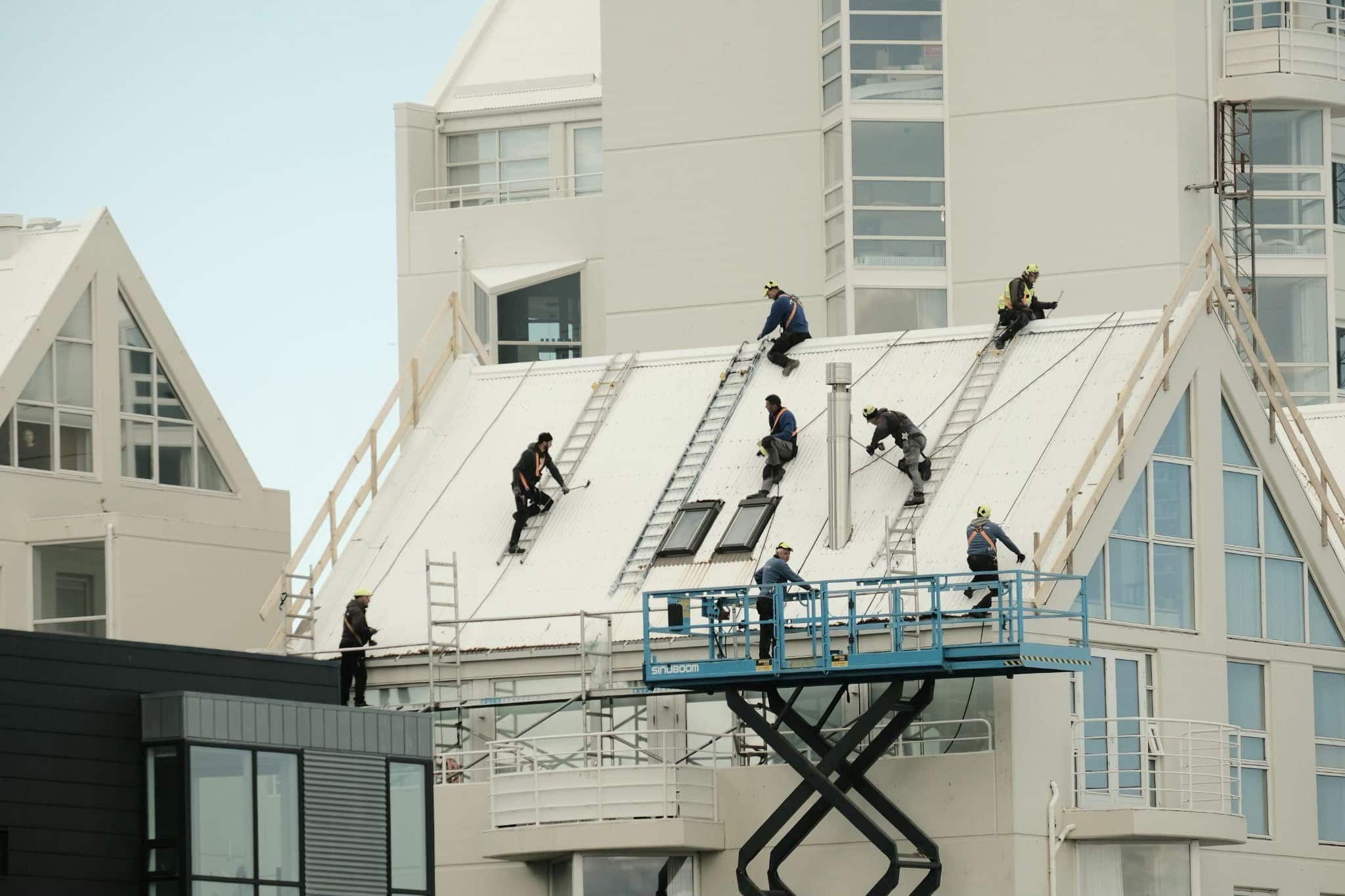
The following article explains what these changing fall protection requirements will mean for contractors and teams working in California. It also explains how to provide general servicing to rooftop equipment, both scheduled and preventative, to ensure a safe and compliant worksite.
Article Overview
- Cal/OSHA’s July 2025 amendments lowered the fall protection trigger height from 15 feet to six feet for residential construction in California.
- There may be a Phase II expansion affecting all construction activities in 2026, although there has not been any official documentation as of May 2026.
- The fall triggers that apply to a given worker depend on the type of work being performed, such as commercial roofing, residential roofing, re-roofing, and rooftop equipment servicing.
- Re-roofing activities remain in a legal gray area due to a contradiction between §1730 and §1731, but contractors are advised to follow the stricter six-foot rule until Cal/OSHA issues formal clarification.
Cal/OSHA’s Changing Fall Protection Requirements
Cal/OSHA proposed legislation in 2025 requiring any construction crew working six feet or more above the ground or floor to provide some type of fall protection. This may include using any of the following:
- Guardrails: Passive barriers you can install around the edge of elevated work areas. They don’t typically require any action from the worker.
- Safety nets: Another type of passive fall protection barrier that’s generally installed below a work area. These are popular around larger construction sites where workers move across a wide area.
- Scaffolding: Temporary, elevated platforms that work more as a surface than a fall protection device. Designed correctly with guardrails and toe boards, you can create a fully protected working environment.
- Personal fall arrest systems: Active systems that require workers to wear a full-body harness connected to an anchor. These are common fall protection systems around fixed ladders and areas where you can’t install traditional guardrails.
If none of these fall protection systems are “feasible” for your worksite, the burden of proof lies on you to approve it. You must also have a fall protection plan in place. This must include controlled access zones and trained safety monitors, which help keep workers safe at heights. Plus, all plans must be developed by a qualified person, customized to specific worksites, and maintained and updated as the work progresses.
You can learn more about these in Cal/OSHA’s published Sections 1671.1 and 1671.2.
Keep in mind Cal/OSHA has announced that similar updates will soon apply to a broader range of construction work. In 2026, the agency plans to lower the fall protection trigger height for all construction activities. Employers should begin preparing now for stricter requirements affecting all branches of construction.
Failure to comply with any of these requirements may result in fines and worksite shutdowns. Most penalties range from $500 and up to $162,851, with higher fines required for more serious violations.
Understanding Roofing Trigger Heights for Fall Protection with Cal/OSHA
All Cal/OSHA trigger heights depend on which regulatory framework applies to you (residential or commercial). That can also heavily depend on your role on the worksite, as well as what you’re doing on a given day.
First, here’s a visual breakdown of each job type, action, and regulatory citation:
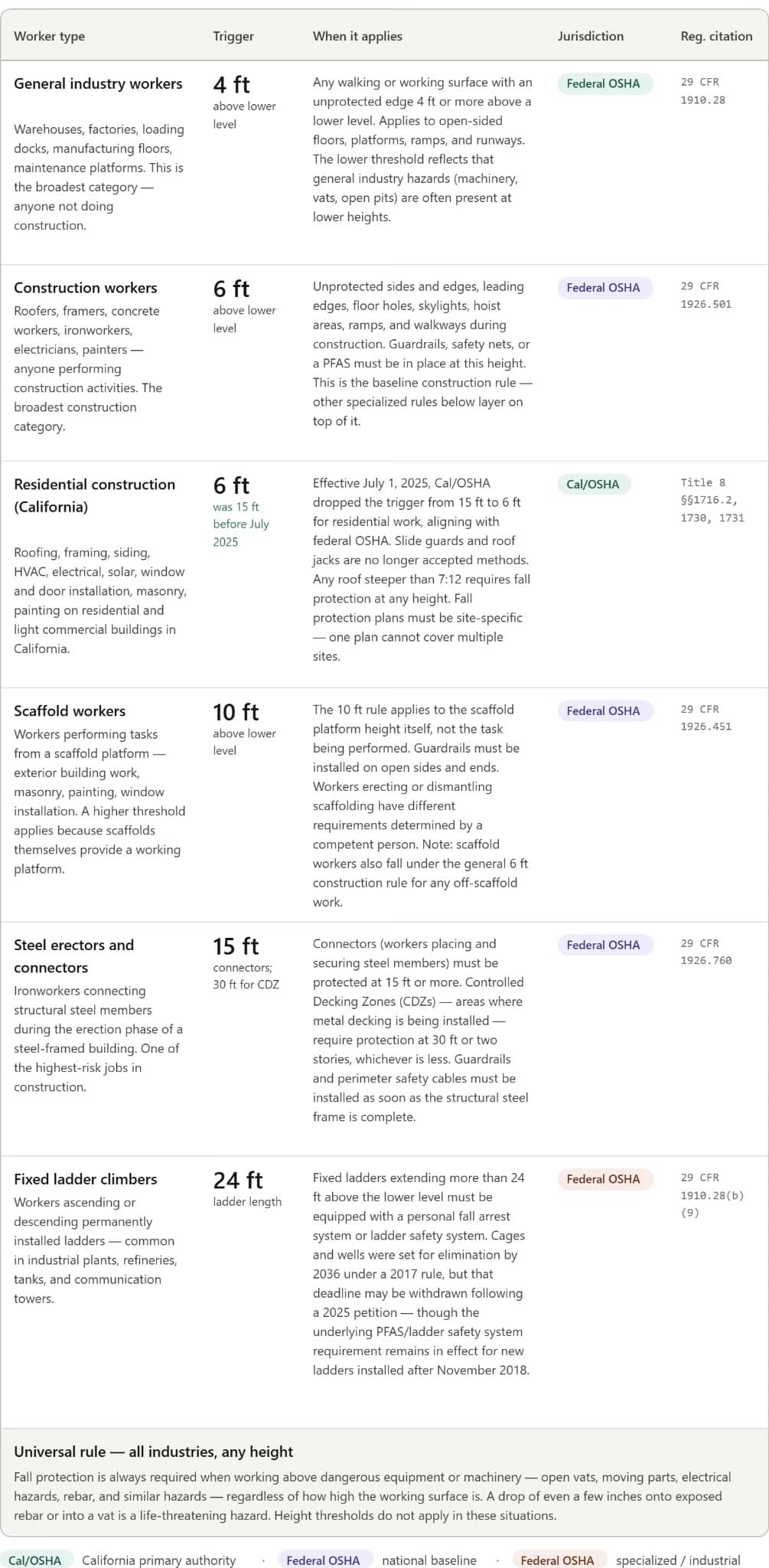
A comprehensive breakdown of OSHA fall protection trigger heights across different worker categories, from general industry to steel erectors. Understanding these regulations is critical for workplace safety compliance.
Now, here’s a more in-depth breakdown of when and how Cal/OSHA’s rules apply in a roofing context:
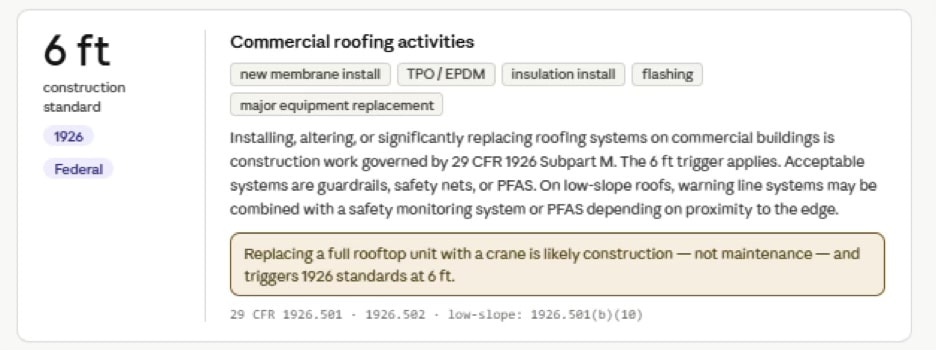
Commercial Roofing
Commercial roofing activities fall under federal OSHA’s construction standard, 29 CFR 1926 Subpart M, with a six-foot trigger height. However, unlike residential roofing, the specific fall protection methods available to commercial roofers depend heavily on roof slope.
- Low-slope roofs (a pitch at or under 4:12). Workers must be protected by guardrail systems, safety net systems, personal fall arrest systems, or a combination of a warning line system with one of those methods. On roofs that are 50 feet or less in width, you can also use a safety monitoring system without a warning line. This covers most commercial flat and membrane roofs.
- Steep-slope roofs (pitch greater than 4:12). Workers must use guardrails with toeboards, safety nets, or a personal fall arrest system. Standalone warning lines and safety monitoring systems are not permitted.
One hazard that applies regardless of slope is skylights. Fall protection is required for skylights at any height. Every skylight must be:
- Covered with a cover capable of supporting twice the weight of workers, equipment, and materials that may be imposed on it
- Secured against displacement
- Marked “HOLE” or “COVER”
- And/or protected by a guardrail system
“If you’re working on a commercial jobsite with multiple trades, keep in mind that fall protection rules don’t automatically transfer between crews. A warning line set six feet from the edge won’t satisfy fall protection requirements for other trades, like HVAC or mechanical workers. Your non-roofing workers either need conventional fall protection, or a warning line set at 15 feet from the edge.” — Michael McCarty, President @ EDGE Fall Protection
Residential Roofing
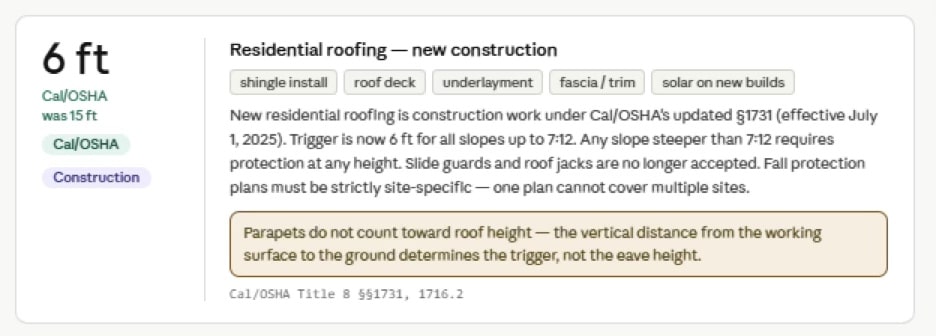
As mentioned, Cal/OSHA’s amendments to §1731 and §1716.2 lowered the fall protection trigger height from 15 feet to six feet for virtually all residential roofing and framing activities.
This includes:
- Shingle installation
- Roof decks
- Skylight installation
- Underlayments
- Fascia and trim installation
- HVAC technicians
- Solar crews
Several previously accepted methods are no longer compliant under the 2025 update. Slide guards, controlled access zones, and roof jacks, for example, are no longer permitted as fall protection systems.
Unless employers can prove these methods are “infeasible,” acceptable fall protection systems are limited to guardrails, safety nets, scaffolding, and personal fall arrest systems.
If it is infeasible to have such fall protection, you must compose a written fall protection plan. As mentioned earlier, it must be developed by a qualified person and customized to your exact worksite.
“Keep in mind roof slopes also affect regulatory guidelines. Low-slope roofs with a pitch between 0:12 and 7:12 require fall protection at six feet or greater. Any roof steeper than 7:12 requires fall protection at any height. However, parapets do not factor into roof height measurement. The trigger depends solely on the vertical distance from the worker’s surface to the ground, not the height of the eave.” — Samantha Hansen, Marketing Manager @ EDGE Fall Protection
Re-Roofing Activities
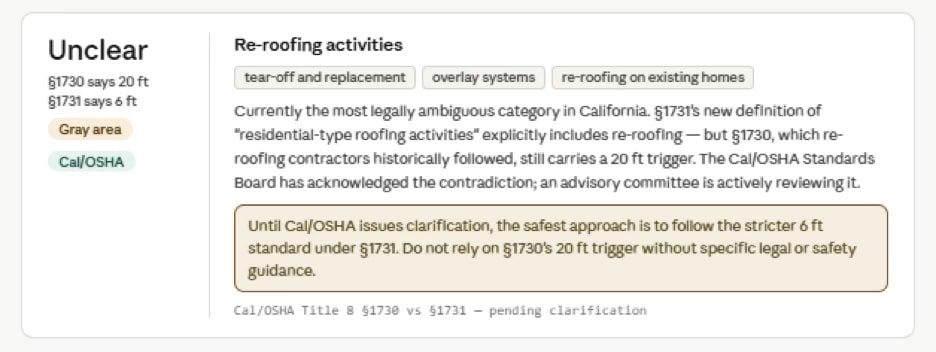
Cal/OSHA’s July 2025 amendments to §1731 explicitly include “re-roofing work, including roof removal” within the definition of residential-type roofing activities. As a result, this would subject it to the new six-foot trigger for fall protection requirements.
However, re-roofing contractors have historically operated under §1730, a separate section that carries a 20-foot trigger. It’s clear there is a direct contradiction between both sections, and Cal/OSHA’s own Standards Board has acknowledged the conflict exists.
That said, Alex Miller, Safety Services Director at Leavitt Group, reached out to the agency’s principal safety engineer for additional insight. He has confirmed that further clarification from the board is forthcoming. But as of now, no formal resolution has been issued.
That said, California roofing contractors are encouraged to operate under the assumption of the six-foot rule.
In Miller’s words:
“Re-roofing operations have been affected in that the language is at best unclear. If you follow the logic of the information provided, then re-roofing operations have been largely unaffected and would not be affected by the rule. However, based on [a] conversation with the principal safety engineer at the Standards Board, this situation is soon to change, and ultimately, everyone will be following the 6-foot rule.” — Alex Miller, Safety Services Director @ Leavitt Group
General Servicing of Rooftop Equipment
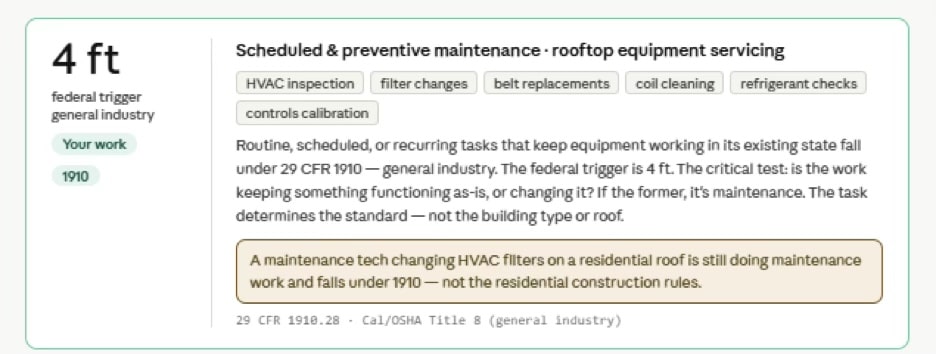
For companies performing scheduled maintenance, preventive maintenance, and general servicing, trigger height relies on Federal guidelines (OSHA 29 CFR 1910.28).
The general industry trigger height is four feet above a lower level, which is two feet lower than the construction standard. If your technicians are on a low-slope roof, and there’s an unprotected edge four feet or more below them, they are required to have fall protection.
1910.28 organizes rooftop requirements by distance from the edge, and not just by height. There are three zones to consider:
- Less than six feet from the edge: the employer must ensure each employee is protected by a guardrail system, safety net system, travel restraint system, or personal fall arrest system. No exceptions. This is the highest-risk zone and the requirements are firm regardless of how brief or routine the task.
- Between six and 15 feet from the edge: Each employee must have access to a guardrail system, safety net system, travel restraint system, or personal fall arrest system. You may also create a designated area to perform work that is both “infrequent” and “temporary.” While painted lines are not enough, you can use a rope, wire, tape, or chain barrier to delineate where work gets done.
- 15 feet or more from the edge: You are not required to provide fall protection when the work is infrequent and temporary. That said, you must implement a rule that prevents employees from going within 15 feet of the roof edge without fall protection.
“Let’s say you have an HVAC tech doing a routine filter change. As long as they’re 15 feet or more away from the roof edge, they probably don’t require a harness. But once they’re between 15 and six feet, they might, unless you can categorize the job as ‘infrequent and temporary.’ Once they get within six feet, you’ll need conventional fall protection, no question.” — Cody Malepsy, Operations Manager @ EDGE Fall Protection
As you can see, there are a lot of numbers in the Cal/OSHA ecosystem. There are many more requirements for fixed ladder and fall protection systems as it relates to roofing and beyond, including grab bars, ladder rungs, guardrails, personal fall protection, rest platforms, safety nets, and beyond.
Otherwise, you can always connect with an EDGE Fall Protection OSHA expert by calling us at (844) 314-1374.
FAQs on Cal/OSHA’s Changing Fall Protection Requirements
Q: What Cal/OSHA fall protection rules apply to people working at heights?
Starting July 1, 2025, Cal/OSHA requires fall protection for workers who are six feet or more above the ground or floor. Employees must have access to guardrails, safety nets, scaffolding, or personal fall arrest systems. If these options aren’t available, there must also be a written fall protection plan with trained safety monitors.
Keep in mind that Cal/OSHA has a Phase II planned that will extend the six-foot fall protection requirement from residential construction to all construction activities.
Q: Did OSHA change its fall protection requirements?
In September 2025, OSHA announced in a memo that it intended to withdraw 1910.28(b)(9)(i)(D) as a deregulatory action. This ultimately removed the deadline obligation of upgrading personal fall protection systems on fixed ladders over 24 feet.
In California, Cal/OSHA made a more substantial change by lowering the fall protection trigger height from 15 feet to six feet. This became effective on July 1, 2025. However, more legislation surrounding this topic may debut in 2026.
Q: What is the difference between type 1 and type 2 fall protection?
Type 1 fall protection, also called passive fall protection, refers to any system that doesn’t require workers to wear or actively engage any personal protective equipment. Common examples include guardrails, safety nets, and hole covers.
Type 2, also called active fall protection, involves PPE that the worker must use directly. The most common examples of these include full-body harnesses, lanyards, self-retracting lifelines, and anchorage connectors.
Note that these are not the same as Class 1 and Class 2 self-retracting lifelines, as defined by ANSI in line Z359.14-2021.
Q: What are the Cal/OSHA fall protection requirements?
As of July 1, 2025, Cal/OSHA requires fall protection for any worker who is six feet or more above the ground or floor. Employers are required to provide guardrails, safety nets, scaffolding, or personal fall arrest systems.
Q: What are the OSHA requirements for fall protection rescue?
Under 1926.502(d)(20), employers must promptly rescue employees in the event of a fall, or ensure that employees are able to rescue themselves. Note that OSHA interprets the word “prompt” to mean ‘quickly enough to prevent serious injury.’ It’s also why employers must have a reliable rescue system in place to suit the particular circumstances of a worksite.