 Now Serving Canada
Best Roof Guardrail Systems for Commercial Flat Roofs (2026)
Choosing the right roof guardrail system for your commercial flat roof isn’t complicated once you understand a simple truth: the best system depends on your roof conditions and how often people access the roof. For most commercial flat roofs with frequent maintenance access, a non-penetrating (ballasted) perimeter guardrail is the best all-around choice because it provides passive fall protection without drilling the roof membrane—provided it’s configured for wind, corners, and roof-surface friction.
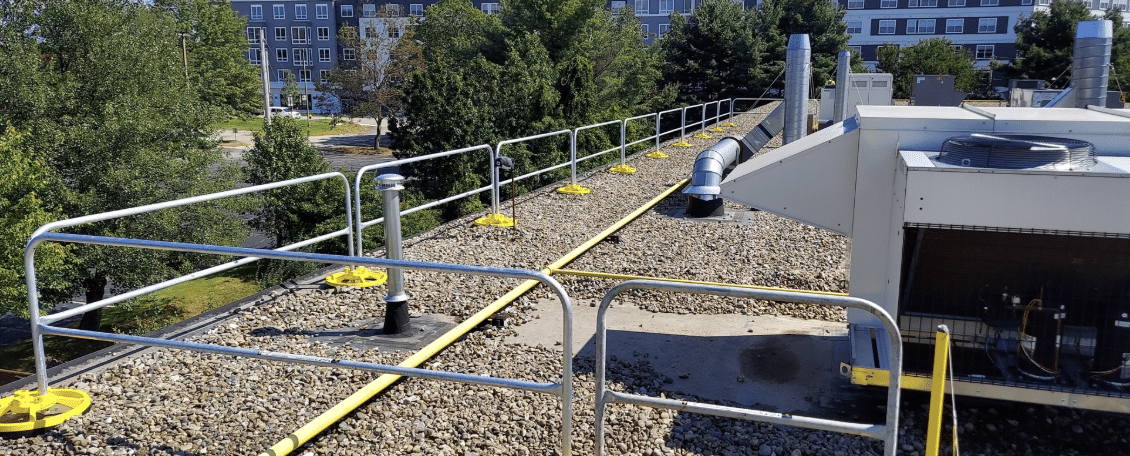
Facility managers across the U.S. face the same challenge every day. They need OSHA-aligned fall protection, roof warranty preservation, fast installation, and systems that don’t leak. Let’s cut through the marketing noise and focus on selection logic, real constraints, and the exact information you need to get an accurate quote.
Quick Answer and System Type Selector
OSHA requires fall protection at 4 feet in general industry and 6 feet in construction. Your roof likely triggers one of those thresholds if workers access it for HVAC maintenance, roof inspections, solar work, or equipment service. The challenge? You need a solution that protects workers without creating roof leaks, voiding warranties, or requiring weeks of downtime.
Guardrails are passive fall protection—meaning they protect workers without requiring them to wear, connect, or actively use equipment each time they approach a hazard. Compare that to harness systems where compliance depends on perfect worker behavior. Guardrails just work. They create a physical barrier between the person and the edge. If your roof is accessed for routine maintenance, a properly configured non-penetrating perimeter guardrail is usually the fastest way to improve safety without adding roof leaks.
The best system for your roof depends on three primary factors: roof membrane type, parapet conditions, and how often people access the roof. Speed matters too. Some systems install in hours. Others take days or require coordination with roofing contractors to flash penetrations correctly. EDGE Fall Protection designs roof guardrail systems around these real-world constraints, not catalog defaults.
Most commercial flat roof fall protection projects fit one of three system categories. Non-penetrating ballasted guardrails work best when you want zero roof penetrations, fast installs, and ongoing maintenance access. Parapet clamp systems excel when you have existing parapets that meet thickness and condition requirements. Mechanically attached (penetrating) systems become necessary when architects or building codes drive permanent guard assemblies, or when high-wind exposure makes ballast impractical. Each system type has a proper use case. Picking the wrong one creates cost overruns, leaks, or compliance gaps.
One important clarification before we go further: guardrails are not tie-off anchors unless explicitly engineered and labeled as such. They’re barriers designed to meet specific strength requirements (top rails must resist at least 200 pounds of force). Fall arrest anchors handle different loads and failure modes. Mixing the two creates serious liability and safety problems.
| System Type | Penetrates Membrane? | Best For | Typical Install Speed | Key Limitations |
|---|---|---|---|---|
| Non-Penetrating Ballasted Perimeter Guardrail | No | TPO, PVC, and EPDM roofs, frequent maintenance access, and roof warranty preservation | Fastest | Wind exposure, corners, roof load capacity, surface friction, and ponding avoidance |
| Parapet Clamp Guardrail | No, clamps to parapet | Roofs with existing parapets in good condition | Fastest | Parapet thickness range, coping details, parapet condition, height, and edge geometry |
| Standing Seam Clamp Guardrail | No, clamps to seams | Metal roofs with compatible standing seam profiles | Fast | Seam profile compatibility, manufacturer-approved clamps, and slope limitations |
| Mechanically Attached Roof-Mounted Guardrail | Yes | High-wind sites, architectural permanence, code-driven guard assemblies, and limited ballast feasibility | Moderate | Requires flashing, waterproofing, roofing contractor coordination, and roof assembly details |
| Wall-Mounted or Exterior-Mounted Guardrail | Attaches to building structure | Narrow roofs, aesthetic edge requirements, and keeping bases off the membrane | Moderate | Structural attachment points, wall construction type, and reach or setback from the edge |
| Temporary Construction Guardrail | Varies | Short-duration construction projects, not ongoing facility operations | Moderate to Fast | Rating or approval for site conditions, proper installation, and limited reuse lifespan |
| Warning Line with PFAS or Horizontal Lifeline | Anchor points penetrate | Areas where perimeter rails are not feasible and low-frequency access zones | Moderate | Worker training required, anchor planning and testing, and reliance on compliance behavior |
OSHA and Code Basics You Must Get Right
OSHA cares about performance, not brand names. Your installed guardrail must meet specific strength criteria, height requirements, and installation conditions. That means documenting your design assumptions, keeping product data sheets available, and knowing which OSHA standard context applies to your work. The best way to avoid citation risk? Understand the minimum compliance concepts that drive system selection and inspection readiness.
Fall protection is required at 4 feet in general industry and 6 feet in construction. That threshold matters because roof work can fall under different OSHA contexts depending on the type of work being performed. Maintenance crews working on HVAC equipment may operate under general industry rules. Construction crews installing solar panels or reroofing trigger construction standards. The distinction affects which fall protection methods are acceptable and how compliance is evaluated.
In construction work, OSHA 1926.501 generally requires fall protection at unprotected roof edges 6 feet or more above a lower level, and guardrails are one of the accepted methods. An unprotected side or edge is any roof edge, opening, or perimeter where a person can fall to a lower level without a barrier or equivalent fall protection. If your project includes rooftop mechanical equipment service access, building codes and mechanical codes may drive permanent access and guarding details beyond temporary jobsite solutions.
The International Mechanical Code provides guidance on worker safety for rooftop service areas. A common requirement is a 42-inch-high guard at elevated edges where equipment service occurs. That height requirement appears across multiple code contexts. Your installed system should meet those height and strength criteria regardless of which standard technically governs your site. Design conservatively. Document everything.
Why does this matter for quotes? If your scope includes permanent rooftop access for ongoing maintenance, you may need to satisfy both OSHA performance requirements and building/mechanical code permanence and height requirements. When you request a quote, specify the work type (maintenance, construction, equipment service) and the frequency of access. Vendors can then recommend systems that meet the relevant performance and durability expectations.
Documentation readiness is simple but often forgotten. Keep your layout drawings, product cut sheets, installation photos, and any engineering letters or PE stamps in a file. If OSHA inspects your site or an internal audit occurs, you want proof that the system was designed for your roof conditions and installed per manufacturer instructions.
Falls remain a leading cause of workplace fatalities. OSHA reported 5,283 fatal work injuries in 2023. Fall protection violations consistently rank among the most commonly cited standards, with 1926.501 appearing frequently in construction citations. Those numbers explain why facility managers prioritize passive systems like guardrails. They reduce reliance on worker behavior and create a default-safe environment every time someone steps onto the roof.
The 7 Main Roof Guardrail System Types
Start with the roof condition, not the catalog. A simple rule applies: frequent access favors passive collective protection first. That means perimeter guardrails over harness-based tie-off systems whenever roof geometry and load capacity allow it. Let’s define each system type in buyer language, list where it excels, and note the constraints that affect quoting and safety.
Non-Penetrating (Ballasted) Perimeter Guardrail
This is a freestanding barrier system that uses weighted bases and layout geometry to stay in place without drilling into the roof membrane. Bases sit on protective pads. Rails connect bases into continuous runs. The system resists sliding, tipping, and wind uplift through a combination of ballast weight, base footprint, friction against the roof surface, and stabilizing layout features like corners and returns.
Best for: TPO, PVC, or EPDM membrane roofs where preserving the roof warranty is non-negotiable. Facilities that need fast installs with minimal roof penetrations. Ongoing maintenance access scenarios where the guardrail stays in place long-term. Warehouses, logistics centers, data centers, and industrial buildings with frequent rooftop HVAC or equipment maintenance.
Constraints: Wind exposure and roof corners are the controlling design conditions. You need proper corner treatment, open-end returns, and sometimes additional ballast in high-exposure zones. Roof surface condition matters (wet, icy, or dusty surfaces reduce friction). Roof load limits and drainage patterns must be verified to avoid ponding or overloading the deck. Rooftop obstructions like piping, conduit, and cable trays can complicate layout.
EDGE’s AccuFit non-penetrating guardrail is designed specifically for these applications. It uses modular bases and rails that configure around real-world roof obstacles without custom fabrication delays.
Parapet Clamp Guardrail
Parapet clamp systems attach directly to the parapet wall using mechanical clamps. The guardrail extends above the parapet to create the required barrier height. Minimal contact with the roof membrane occurs, and installation is often faster than ballasted systems because the parapet provides the structural anchor.
Best for: Roofs with existing parapets in good structural condition. Parapet thickness typically must fall within a specified range (often 4 to 24 inches). Works well when you want to preserve roof walking area and reduce the footprint of bases on the membrane.
Constraints: Parapet condition is the gating factor. Damaged, deteriorated, or out-of-tolerance parapets won’t support clamps safely. Coping details, parapet height, and edge geometry (corners, returns) all affect feasibility and layout. Not all parapet profiles are compatible with off-the-shelf clamp systems. Custom brackets may be required.
EDGE offers a parapet clamp guardrail that adjusts to a range of parapet thicknesses and coping profiles. It’s a fast-install option when your parapet meets the criteria.
Standing Seam Clamp Guardrail (Metal Roofs)
For metal roofs with standing seam profiles, clamp-on guardrails attach to the raised seams without penetrating the roof panel. The clamp grips the seam mechanically, and the rail extends upward to form the barrier. This avoids creating leak points through the metal panels.
Best for: Metal roofs with compatible standing seam profiles. Facilities where drilling metal panels is prohibited by roof warranty or facility policy. Roof slopes up to the manufacturer’s rated limits (often around 3:12 or 4:12, depending on the system).
Constraints: Seam profile compatibility is non-negotiable. Not all standing seam profiles work with standard clamps. Some require manufacturer-approved clamps specific to the panel system. Slope limitations apply because clamps rely on friction and geometry to resist sliding. Always verify compatibility with your metal roof manufacturer before ordering.
EDGE’s metal roof guardrail includes clamps engineered for common standing seam profiles. Verify compatibility during quoting to avoid surprises.
Roof-Mounted (Mechanically Attached) Guardrail
Mechanically attached systems fasten posts through the roof assembly into the structural deck. Each post penetration requires proper flashing and waterproofing to prevent leaks. This approach creates a permanent, anchored barrier that handles high wind loads and architectural requirements for fixed guards.
Best for: High-wind exposure zones where ballasted systems can’t meet uplift requirements. Architectural or code-driven permanent guard assemblies. Situations where roof load capacity limits ballast weight. Long-term installations where the added cost and coordination of flashing penetrations is justified by performance or permanence needs.
Constraints: Requires close coordination with your roofing contractor to flash penetrations correctly and maintain roof warranty. You need to know your roof assembly type, deck material, and fastener pull-out capacity. Installation is slower than non-penetrating systems. Any future roof replacement or repair work must address the posts.
Wall-Mounted or Exterior-Mounted Guardrail
Wall-mounted systems attach to the building structure (exterior wall or parapet face) rather than the roof surface. This keeps the guardrail bases off the membrane entirely and can preserve roof walking space on narrow roofs or where aesthetics matter.
Best for: Narrow roofs where roof-mounted bases would block access paths. Situations where keeping all hardware off the membrane is required. Aesthetic-driven projects where minimizing visible rooftop equipment is a priority.
Constraints: Requires suitable structural attachment points on the wall. Wall construction type (masonry, metal panel, concrete) affects fastener selection and capacity. Reach and setback from the roof edge must be verified to ensure the rail height meets requirements at the actual edge. Structural capacity of the wall must be confirmed.
Temporary Construction Guardrail (Job-Built or Modular)
Temporary systems are designed for shorter-duration construction projects rather than ongoing facility operations. They can be job-built from lumber and hardware or modular metal systems. The key distinction is project-duration scope, not performance.
Best for: Construction projects with defined start and end dates. Roofing or solar installation work where the guardrail is removed once the project completes. Situations where a permanent system isn’t justified by access frequency.
Constraints: Must still be rated and appropriate for your site conditions. Proper installation is non-negotiable (loose or under-ballasted temporary rails fail in wind). Limited reuse lifespan compared to commercial modular systems. Ensure the system meets OSHA strength requirements and is installed per manufacturer or design specs.
Warning Line Plus PFAS or Horizontal Lifeline
Warning line systems create a setback boundary on the roof. Workers know not to cross the line without tying off. Combined with a personal fall arrest system (PFAS) or horizontal lifeline, this approach controls access to hazard zones rather than creating a physical edge barrier.
Best for: Areas where perimeter guardrails aren’t feasible everywhere. Low-frequency access zones where training workers on tie-off procedures is practical. Controlled work zones where you can enforce administrative controls reliably.
Constraints: Relies on worker behavior and training. Every worker must know the rules and follow them. Anchor points must be planned, installed, and tested. Horizontal lifelines require engineering and regular inspection. This is an active protection method, not passive like guardrails. It works, but it demands more from your safety program.
According to market research, the collective protection segment (which includes guardrails) is projected to grow at the fastest rate, with a CAGR of 8.2% from 2026 to 2033. That trend reflects a shift toward passive systems that protect everyone on the roof without requiring individual compliance actions.
How Non-Penetrating Guardrails Stay Secure Without Anchors
A non-penetrating roof guardrail stays in place by combining ballast weight, base friction, and stabilizing layout geometry to resist sliding, tipping, and wind uplift—without drilling into the roof. That’s the short answer. Now let’s explain the engineering concepts in practical terms so you can verify system configurations during the quote process and understand what to check during inspections.
Three failure modes control non-penetrating guardrail design: sliding, tipping, and uplift. Each has a different cause and solution. Understanding all three helps you ask the right questions when you review vendor proposals.
Resisting Sliding
Sliding occurs when horizontal forces (like someone pushing against the rail or wind pressure) overcome the friction between the base and the roof surface. Friction depends on two factors: the normal force (weight pressing down) and the coefficient of friction between the base pad material and the roof membrane.
Heavier bases create more normal force. Pads designed for your membrane type optimize friction. Clean, dry surfaces provide better friction than wet, icy, or dust-covered roofs. That’s why manufacturers specify pad materials and why you should clean the roof surface before installation. Surface prep isn’t optional. It’s a design assumption.
Ballast is intentionally added weight used to increase a guardrail’s resistance to movement by increasing friction against the roof and increasing the restoring moment that resists tipping. More weight equals more friction and better stability. But there’s a limit. You can’t overload the roof deck. Verify your roof’s load capacity before adding ballast.
Resisting Tipping (Overturning)
Tipping happens when wind or side loads create a moment (rotational force) around the base edge. Picture someone leaning heavily on the top rail. That creates a tipping moment trying to rotate the base. The system resists tipping through ballast weight, base footprint (wider is more stable), and layout continuity.
Connected rails in continuous runs share loads across multiple bases. A single base might tip if isolated, but when connected to adjacent bases in a continuous run, the system behaves as a unit. Corners and returns add significant stability because they create geometric bracing. A straight run of rail can slide or tip more easily than a system with 90-degree corners tying runs together.
Resisting Uplift
Roof edges and corners experience suction forces from wind. Air flowing over and around the building creates negative pressure zones that try to lift objects off the roof. Corners and open ends are the most demanding zones because wind effects concentrate there.
That’s why proper corner treatment and open-end returns are non-negotiable in non-penetrating designs. An open end (a rail run that terminates without turning a corner or connecting to another run) is vulnerable to uplift. Returns—short perpendicular sections at the end of a run—add weight and geometric stability to resist uplift. Corner bases often require additional ballast or specific configurations to handle the combined tipping and uplift forces.
Continuity and Geometry
The layout matters as much as the base weight. Continuous runs, properly configured corners, and returns create a system that’s exponentially more stable than isolated sections. Think of it like a fence: a single post tips easily, but a connected fence line resists much higher forces.
When you request a quote, ask how the vendor handles corners, open ends, and high-exposure zones. Ask for layout drawings showing base placement and corner details. Verify that the system configuration accounts for your roof’s wind exposure and edge conditions.
Procurement Translation: Questions to Ask Vendors
- How do you configure corners and open ends to resist uplift?
- What roof surface preparation is required for proper friction?
- What is the base weight per linear foot, and does it meet my roof’s load limits?
- Are setbacks from the edge required to reduce wind exposure?
- What inspection and maintenance procedures ensure long-term stability?
- How is roof load distributed across the deck (point loads vs. distributed loads)?
Things Not to Do
Don’t tie off to guardrails unless they’re rated and labeled as anchors. Don’t add ad-hoc weights or adhesives unless the manufacturer or a licensed engineer approves them. Don’t skip surface cleaning before installation. Don’t assume all non-penetrating systems are equivalent. Configuration and engineering matter.
A NIOSH evaluation found that all 45 guardrail configurations tested met the OSHA 200-pound top rail requirement. One commercial non-penetrating system installed 32% faster than a job-built configuration (25.6 minutes vs. 37.9 minutes per section). Speed and performance both matter.
When to Use Each System Type
Selection comes down to a simple framework: frequency of access, roof type, and edge condition (parapet or no parapet) determine the baseline. Wind exposure and obstructions determine the configuration. Let’s translate that into real-world scenarios so you can map your facility to the right system package.
Scenario A: Logistics Warehouse Maintenance
You manage a 200,000-square-foot warehouse with multiple roof edges, routine HVAC and roof drain access, and a strong preference for minimal penetrations to preserve your roof warranty. Crews access the roof weekly for preventive maintenance and emergency repairs.
Recommended system: Non-penetrating perimeter guardrail installed around all unprotected edges, with self-closing gates at primary access points (roof hatches, ladder tops), and transition protection at roof hatches. This creates a passive safety zone that protects every worker without requiring daily tie-off decisions. EDGE’s roof hatch guardrail integrates with perimeter systems to eliminate the gap between the hatch opening and the perimeter rail run.
Quote inputs: Roof plan showing all edges, total linear feet by run, locations of roof hatches and ladder access points, parapet heights (if any), photos of corners and roof obstructions, roof height above grade, wind exposure (if known).
Scenario B: Rooftop Solar Installation on Membrane Roof
You’re installing solar panels on a TPO membrane roof. The project will take three months. Workers will be near edges daily during panel installation, racking assembly, and electrical work. You cannot penetrate the membrane without voiding the roof warranty.
Recommended system: Temporary non-penetrating perimeter guardrails where feasible, combined with warning lines and PFAS in controlled work zones if full perimeter coverage isn’t practical. Prioritize edge zones with the highest worker density and fall risk. If budget allows, install full perimeter rails. The time saved on safety training and reduced tie-off compliance monitoring often justifies the rail cost.
Quote inputs: Roof plan, edge linear feet, panel installation timeline, worker count, staging area locations, membrane type, any restrictions on roof loading or access.
Scenario C: Parapet Roof
Your building has 8-inch parapets around the perimeter. They’re in good condition with minimal cracking or spalling. You need fall protection for semiannual HVAC filter changes and annual roof inspections.
Recommended system: Parapet clamp guardrail for speed, reduced roof contact, and simplified installation. Verify parapet thickness, coping details, and condition during site survey. If parapets don’t meet clamp system requirements, you’ll need ballasted or wall-mounted alternatives.
Quote inputs: Parapet dimensions (height, thickness, coping type), edge photos showing parapet condition, linear feet needed, corner details.
Scenario D: High-Visibility or Public-Facing Building
You manage a corporate headquarters with a green roof accessible to employees. Aesthetics matter. The building owner wants low-visibility fall protection that doesn’t detract from the rooftop garden design.
Recommended system: Consider architectural rail profiles, powder-coated finishes, or wall-mounted systems that minimize rooftop footprint. Don’t sacrifice performance for looks. Attractive doesn’t mean compliant. Verify that any architectural system still meets OSHA strength and height requirements. Form follows function in safety applications.
Quote inputs: Roof plan, edge conditions, aesthetic requirements (color, profile), structural attachment options if wall-mounting is preferred.
Scenario E: Very Limited Roof Area or Narrow Setbacks
Your building has a narrow rooftop walkway (3 feet wide) between the edge and rooftop equipment. Roof-mounted guardrail bases would block the only walking path.
Recommended system: Wall-mounted or exterior-mounted guardrail attached to the building structure or parapet exterior face. This keeps the walking surface clear while still providing edge protection.
Quote inputs: Wall construction type, attachment point availability, edge offset distance, walking path width, structural capacity verification.
For warehouses with routine roof access, the safest “set it and forget it” approach is usually a full-perimeter non-penetrating guardrail plus guarded access points—because it protects every worker without relying on daily tie-off behavior. Harness systems still have a role for localized hazards and temporary tasks, but perimeter rails create the foundational safety layer.
Quote Checklist and One-Page Worksheet
The fastest way to get an accurate roof guardrail quote is to provide a roof plan, total linear feet by edge, roof membrane type, parapet heights, access points, roof height above grade, and where gates or toeboards are needed. If you send the following items, you’ll usually get a faster, more accurate quote with fewer back-and-forth revisions. This is the practical checklist facility managers wish they had before their first call to a vendor.
- Roof Plan and Perimeter Takeoff. Attach a PDF roof plan, CAD file, or marked-up satellite image. Indicate which edges need protection and measure or estimate total linear feet by edge or run.
- Roof Membrane Type and Condition. Specify membrane type (TPO, PVC, EPDM, BUR, modified bitumen, etc.) and note any coatings, surface treatments, or freeze-thaw conditions.
- Roof Height Above Grade and Building Exposure. Report roof height above grade and note whether your building is in an open field, urban area, or coastal zone.
- Parapet Details. Measure parapet height, thickness, and coping type. Take photos and note any damage or deterioration.
- Access Points and Gate Locations. Mark all roof hatches, ladder tops, stairway doors, and mechanical penthouses where gates are needed.
- Rooftop Obstacles. Identify HVAC units, skylights, exhaust fans, piping, cable trays, conduit runs, solar panels, and other obstructions near edges.
- Operational Use and Access Frequency. Describe how you use the roof and estimate worker count and access frequency.
- Falling Object Risk and Toeboard Needs. Identify areas above walkways, entrances, parking lots, or public spaces where toeboards may be required.
- Install Constraints and Site Logistics. Note crane or hoist availability, staging areas, roof load limits, and any restricted work hours.
- Documentation Requirements. Specify whether you need CAD or shop drawings, engineering review, PE stamps, or as-built drawings.
- Photos of Corners and Obstructions. Include a reference object for scale to eliminate ambiguity.
- Timeline and Budget Expectations. Share your installation timeline and budget context to help vendors propose solutions that fit your constraints.
Copy this checklist, fill in your details, and email it to vendors. You’ll get better quotes faster. When you’re ready, talk to an EDGE specialist who can walk through your specific site conditions and recommend the right system configuration.
Installation, Inspection, and Ownership Costs
The best roof guardrail is the one that stays compliant after your next reroof, storm, or equipment replacement. Installation quality matters, but long-term performance depends on inspections, documentation, and planning for roof work that might disrupt the guardrail layout.
Installation Planning and Roof Coordination
Plan material staging before the crew arrives. Clear the roof edge zone of debris, tools, and stored equipment. Verify that drainage paths won’t be blocked by bases. Avoid placing bases in areas prone to ponding water. Coordinate with your roofing contractor if you have warranty concerns or if any flashing work is required (for penetrating systems).
Hoisting equipment to the roof is faster and safer than hand-carrying bases and rails up ladders. If crane access isn’t available, budget extra labor time for manual material handling. Protect the roof membrane during installation with base pads designed for your membrane type.
Installation time varies by system type and site conditions. The NIOSH study found that one commercial modular guardrail system installed 32% faster than a job-built alternative (25.6 minutes vs. 37.9 minutes per section).
Inspection Cadence and Triggers
Inspect guardrails immediately after installation to verify correct base placement, corner configuration, and gate operation. Inspect after major storms (especially high winds) to check for shifted bases, damaged rails, or loosened connections. Inspect after any roof work that required moving or removing sections of the guardrail. Plan periodic inspections (semiannual or annual depending on use frequency) to verify torque on modular connections, base condition, and pad wear.
Most long-term guardrail failures are caused by changed conditions, not the original installation. A thunderstorm with 60 mph gusts can shift improperly configured bases. Reroofing crews may remove sections and not reinstall them correctly. Your inspection program must catch those issues before someone falls.
Documentation Package and Compliance Records
Maintain a documentation package that includes as-built layout drawings, product data sheets (showing OSHA compliance and load ratings), installation photos (especially corners, gates, and returns), and an internal inspection checklist template. Keep a photo log of corner and return configurations so you can verify correct reinstallation after roof work.
Ownership Cost Considerations
Initial cost includes equipment, engineering (if required), installation labor, and any crane or material handling. Ownership costs include inspections, any base or rail replacements due to damage or wear, reconfiguration after roof layout changes, and documentation updates.
Non-penetrating systems generally have lower ownership costs because they don’t require flashing maintenance or roof penetration monitoring. Mechanically attached systems may need flashing inspections and resealing over time. Factor those costs into total cost of ownership when comparing system types.
EDGE Fall Protection’s Recommended Approach
EDGE designs roof fall protection around how your facility actually uses the roof—then matches the system type to your membrane, parapet conditions, access points, and exposure. This isn’t about selling one product family. It’s about engineering the right solution for your specific roof conditions and operational needs.
EDGE Fall Protection’s baseline strategy is to prioritize collective protection—like perimeter guardrails—because it protects every authorized roof user without relying on perfect tie-off behavior. The market data supports this shift, with collective protection systems projected to grow at a CAGR of 8.2% through 2033.
Primary Recommendation for Most Commercial Flat Roofs
Non-penetrating perimeter guardrails are the default recommendation for most flat commercial roofs where minimizing roof penetrations is a priority. They install fast (often same-day for smaller roofs). They preserve roof warranties. They provide passive protection that works regardless of worker training or compliance. When configured correctly for corners, wind exposure, and roof surface conditions, they meet OSHA requirements and deliver long-term safety performance.
Where EDGE Often Wins on Speed and Support
EDGE excels at modular layouts around obstacles. Standard catalog systems struggle with rooftop HVAC units, piping runs, cable trays, and irregular edge geometries. EDGE provides internal engineering support to configure systems for real-world roof conditions without custom fabrication delays. CAD and layout support help facility teams visualize the installation before ordering. Accessories like roof hatch guards, ladder guards, skylight fall protection, toeboards, and gates integrate into a complete rooftop safety program.
Credible Fit Checks and When EDGE Recommends Alternatives
EDGE doesn’t force every project into one system type. Where parapets are suitable, EDGE may recommend parapet clamp systems for faster installation and reduced roof contact. For standing seam metal roofs, EDGE offers clamp-on guardrails that avoid panel penetrations. When high-wind exposure or architectural requirements drive the need for mechanically attached systems, EDGE provides those too—with engineering support for flashing coordination and structural attachment.
If ballast or space constraints make perimeter rails impractical, EDGE works with you to design hybrid solutions combining warning lines, localized guardrails at high-risk zones, and PFAS where necessary. Honest assessment of site constraints builds trust and ensures the right system gets installed.
Connect to Procurement
EDGE can work from a roof plan and photos. Use the quote checklist worksheet from this guide to gather site details before your first call. Send the completed worksheet along with your roof plan and photos. EDGE’s team will recommend system types, provide preliminary layouts, and return a quote package with configuration guidance.
Frequently Asked Questions
Are non-penetrating roof guardrails OSHA compliant?
Yes—non-penetrating roof guardrails can be OSHA compliant if the installed system meets guardrail performance criteria, including required strength and proper configuration for the site. OSHA focuses on performance, not attachment method. The system must resist at least 200 pounds of force applied to the top rail and maintain proper height (typically 42 inches). Configuration details like corners, returns, and surface conditions affect compliance. Ask your vendor for documentation showing the system meets OSHA requirements and is configured for your roof type, layout, and wind exposure.
How does a non-penetrating guardrail stay secure without anchors?
It stays secure by using ballast weight, friction against the roof surface, and stabilizing layout geometry to resist sliding, tipping, and wind uplift. The system combines heavy bases, protective pads that optimize friction for your membrane type, and continuous connected runs with properly configured corners and returns.
Do ballasted guardrails damage TPO, PVC, or EPDM membranes?
They shouldn’t when installed with the correct protective pads and on a clean surface, but you still need to verify membrane compatibility and avoid creating ponding paths. Pads distribute base weight and protect the membrane from abrasion. Inspect pads and membrane contact areas after storms and roof work to ensure no damage or displacement has occurred.
Can I use a roof guardrail as a tie-off anchor?
No—unless the manufacturer specifically designs, labels, and documents it as an anchor point, a guardrail should not be used for tie-off. Guardrails are barriers designed to meet OSHA strength requirements for preventing falls (200 pounds of top rail force). Fall arrest anchors must handle much higher loads (typically 5,000 pounds) and different failure modes. Using a guardrail as an anchor creates serious safety and liability risks.
What’s better for a warehouse roof: guardrails or harness tie-off?
For frequent maintenance access, perimeter guardrails are usually better because they provide passive protection for every user without daily tie-off steps. Harness systems still have a role for localized hazards, temporary tasks, and areas where guardrails aren’t feasible. But for routine warehouse roof access, perimeter guardrails deliver better long-term safety performance with lower compliance burden.
What information do I need for a roof guardrail quote?
Send a roof plan, total linear feet by edge, roof membrane type, parapet heights, access points, roof height, and where gates or toeboards are needed. Include photos of corners and obstructions. Specify how you use the roof and access frequency, plus any install constraints like crane availability or restricted work hours.
When do I need toeboards on a roof guardrail?
Use toeboards when tools or materials could be kicked or slid off the roof edge, especially above walkways, entrances, or public areas. Toeboards are 4-inch-high kickplates installed at the base of the guardrail to prevent objects from rolling or sliding under the bottom rail.
What if my roof has a parapet—do I still need guardrails?
A parapet can reduce risk, but you still need to evaluate whether the effective barrier height and edge conditions meet your safety and code requirements for the work being performed. A 24-inch parapet doesn’t provide the same fall protection as a 42-inch guardrail. Parapet clamp guardrails can extend the barrier height quickly and affordably if your parapet is in good condition and meets dimensional requirements.
Conclusion
Selecting the best roof guardrail system for your commercial flat roof comes down to understanding three things: your roof conditions, how often workers access the roof, and what constraints you face around roof penetrations, budget, and timeline. Non-penetrating ballasted guardrails work best for most membrane roofs with frequent maintenance access. Parapet clamp systems excel when suitable parapets exist. Mechanically attached systems handle high-wind or code-driven permanent guard requirements. Each system has a proper use case.
EDGE Fall Protection designs roof guardrail systems around real-world constraints. We prioritize collective protection systems that protect every worker without relying on perfect tie-off behavior. We provide engineering support, layout assistance, and complete accessory integration from roof hatches to toeboards. If you manage safety for warehouses, logistics facilities, data centers, or rooftop solar projects, contact EDGE to discuss your specific site conditions and get a system recommendation tailored to your roof.