 Now Serving Canada
Aviation Fall Protection for Aircraft Hangars
Aircraft Maintenance Fall Protection From Nose to Tail
Aircraft maintenance puts technicians on wings, fuselage crowns, stabilizers and engine nacelles: curved, polished surfaces that are often wet, with nothing on the aircraft to tie off to. Add work stands, parts mezzanines and the hangar roof, and an aviation or aerospace facility has fall hazards in almost every bay. Under OSHA’s general industry rules, work 4 feet or more above a lower level needs fall protection.
EDGE Fall Protection designs overhead rigid rail, horizontal lifelines, portable fall arrest and access stands around the aircraft you maintain, so technicians stay protected from nose to tail without drilling or bolting anything to the airframe. We engineer to your hangar structure, install with our own crews and inspect every system each year.
Where Technicians Need Aircraft Fall Protection
Most aviation fall exposure comes from standing on the aircraft itself. These are the hazards hangar and MRO teams bring to us most often.
Wings and Fuselage
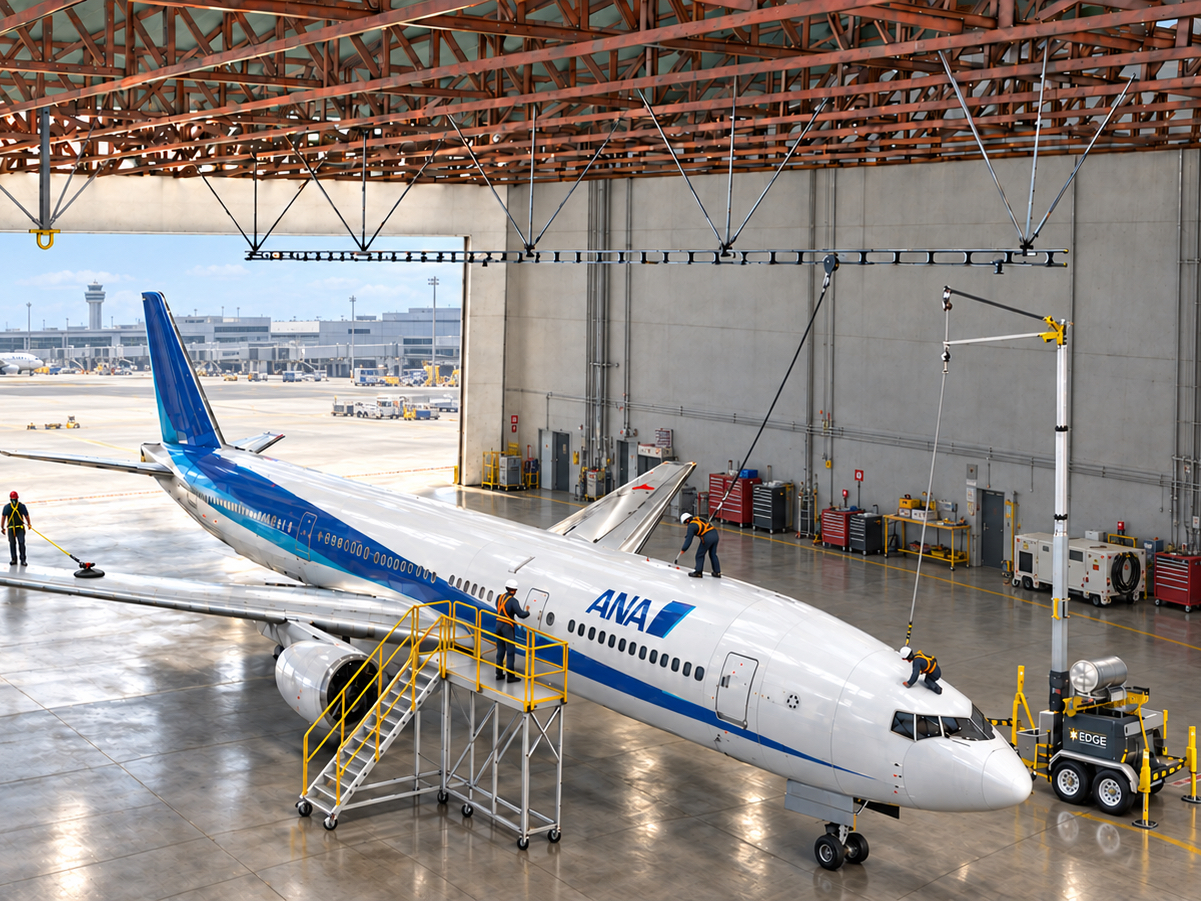
Wing walks and fuselage crowns are curved, slick and high off the hangar floor. Ceiling-mounted rigid rail keeps the technician’s lifeline overhead along the whole aircraft.
Tail and Engine Access
Stabilizers and engines put technicians at the highest points of the aircraft. Work platforms give them guarded footing at working height instead of a ladder.
Hangars Without Overhead Structure
Not every hangar roof can carry a fall arrest load. Freestanding cantilever rigid rail stands on its own base beside the aircraft.
Ramp and Line Maintenance
On the ramp and flight line there is nothing overhead to tie off to. A portable fall arrest unit rolls to the aircraft and raises a rated anchor above the technician.
Doors and Access Panels
Ladders leave technicians reaching instead of working. Portable stair systems with locking casters put a guarded landing at the aircraft door or access panel.
Mezzanines and Hangar Roofs
Parts mezzanines and hangar roofs with skylights are open edges too. Mezzanine safety gates and skylight screens close them off.
Aircraft Hangar Fall Protection Systems
These are the systems we install most often in hangars and aircraft maintenance facilities. Send us your hangar drawings and the aircraft you maintain, and we’ll lay out the coverage.

Ceiling Mounted Rigid Rail
Continuous overhead protection suspended from the building structure, with zero floor footprint.

Freestanding Cantilever Rigid Rail
Continuous overhead protection along a full work line, on a counterweighted base with no building attachment.

Free Standing Swing Arm
A rotating overhead anchor on a freestanding base — coverage across a work area with no building modification.

Portable & Mobile Fall Arrest System
A rated overhead anchor on wheels — rolls to the work, sets up in minutes, no installation required.

Horizontal Lifeline System
Continuous tie-off across long spans, engineered to your structure, span, and simultaneous user count.

Column Fold Away
A column-mounted arm that folds flat against the column when not in use, using zero floor space.

Industrial Platform
A stable, guarded work surface for tank tops, hoppers, mixers, and machinery access.

Portable Stair Systems
Rolling stairs with locking casters — compliant access that moves to where the work is today.

Metal Stairs
Industrial stairways engineered to OSHA 1910.25 geometry, built to your rise and configuration.

Horizontal Mezzanine Safety Gate
A pivoting dual-gate system that always leaves one side of the mezzanine opening protected — with no overhead clearance required.

Self-Closing Ladder Safety Gate
A spring-loaded gate at the top of a fixed ladder that closes behind the climber automatically.

360° Mobile Safety Rail
Our most versatile freestanding guardrail — weighted bases, no penetrations, and fully relocatable as your rooftop changes.

Skylight Screen
The practical, cost-effective screen for protecting a standard skylight opening across a whole roof.
Nationwide OSHA Compliant Fall Protection
Why Aviation and Aerospace Teams Choose EDGE
Hangar managers and MRO safety leads need fall protection that fits a changing mix of aircraft. We design it, engineer it, install it and inspect it.
- Coverage planned around your aircraft: rail runs and trolleys laid out for wingspan, tail height and how many technicians work at once
- Nothing drilled into the airframe: anchors come from the hangar structure, a freestanding base, a mobile unit or an approved vacuum anchor
- Engineered and stamped: EDGE calculates the loads, and a licensed professional engineer stamps the drawings after your approval
- Our own installation crews, scheduled around aircraft movements and hangar availability, in all 50 states and Canada
- Trained by MSA on the WinGrip vacuum anchor system for wing and fuselage access
- Ongoing support: annual inspections and five-year anchorage pull tests from our in-house team
Our Happy Clients
We are grateful for the wonderful testimonials from our happy and beloved clients. From local businesses owners to Fortune 500 executives. You all have helped make us a force in the workplace fall protection industry!
Aviation Fall Protection FAQ
Hangar managers, MRO safety leads and facility engineers ask these questions first. Here are straight answers.
Not for maintenance employers. FAA Order 3900.65A sets fall protection requirements for the FAA’s own Flight Standards personnel at heights of 4 feet or more. For private employers, aircraft maintenance falls under OSHA’s general industry rules, which require fall protection on walking-working surfaces 4 feet or more above a lower level (29 CFR 1910.28(b)(1)(i)), or under an OSHA-approved state plan. EDGE Fall Protection designs aviation systems to OSHA and ANSI Z359 requirements.
Often, once the structure is checked. A fall arrest anchorage has to carry the required loads, and many hangar trusses were not designed for them. EDGE Fall Protection reviews your structural drawings and calculates the loads, and a licensed professional engineer stamps the design after your approval. Where the structure cannot carry rail, freestanding cantilever rigid rail or a free standing swing arm stands on its own base beside the aircraft.
With equipment that comes to the aircraft. A portable and mobile fall arrest unit rolls into position and raises a rated overhead anchor, with no installation. EDGE Fall Protection also supplies the MSA WinGrip AIO vacuum anchor, which attaches to approved smooth aircraft surfaces with no drilling, for wing and fuselage work in the hangar or on the apron. Approvals vary by aircraft, so surface suitability is confirmed before each use.
Technicians should check their equipment before each use, and EDGE Fall Protection recommends a documented inspection of the full system by a competent person at least once a year. EDGE also pull tests anchorages every five years. Our in-house inspection team handles both and gives you a report for your safety records.