 Now Serving Canada
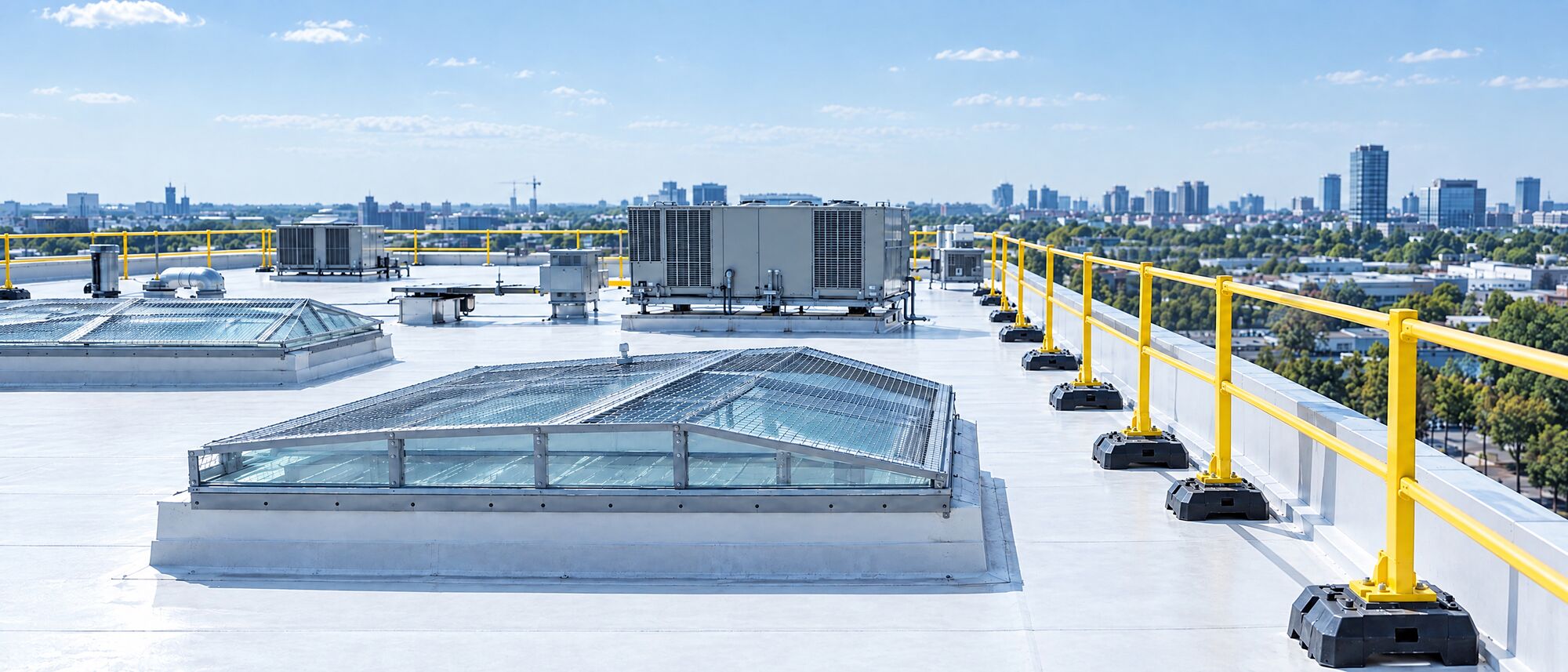
Building Maintenance and Roofing Fall Protection
Facility Manager Roof Access, Safe for Every Trade That Goes Up
A commercial roof sees more foot traffic than most owners realize. HVAC technicians, roofers, electricians, window cleaners and your own maintenance staff all work up there, often near an open edge, a roof hatch or a skylight, and often with no one from the facility team watching. Fall protection has been OSHA’s most-cited standard for 15 years in a row, and in FY2025 federal OSHA cited roofing contractors in 86.5 of every 100 inspections, the highest rate of any construction trade.
EDGE Fall Protection protects the whole path a technician takes: ladders and vertical lifelines to reach the roof, roof hatch guardrail at the access point, 360 Mobile Safety Rail and horizontal lifelines along the edge, and roof davits for work over the side. We assess the roof, engineer the layout, install it with our own crews and come back each year to inspect it.
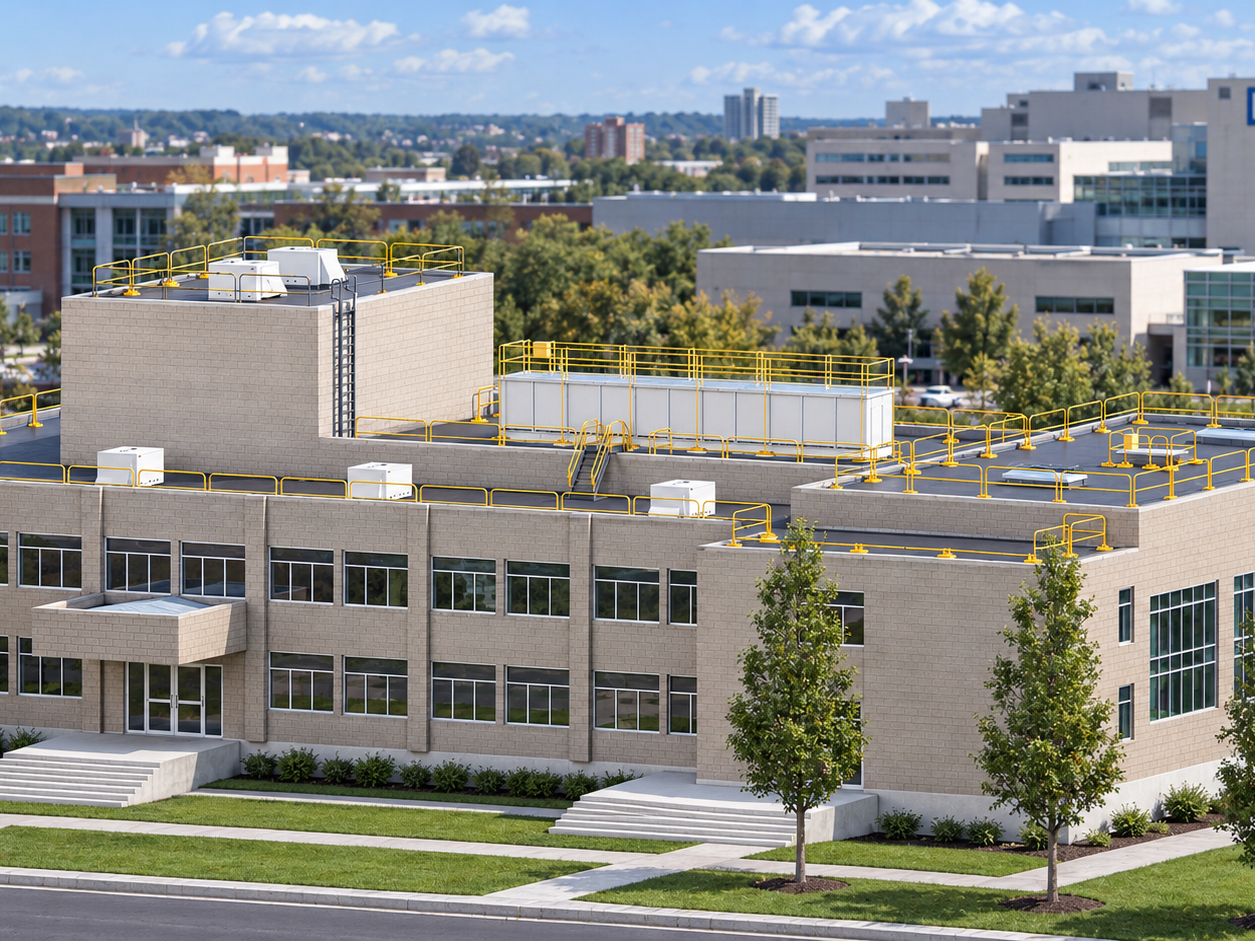
Where Falls Happen Along the Rooftop Walkway
Building maintenance puts people on the roof for a dozen different reasons. These are the hazards facility managers and roofing contractors ask us to guard most often.
Roof Edges and Open Perimeters
The open roof edge is the most obvious hazard up top. The 360 Mobile Safety Rail sits on weighted bases, so there is no drilling into the roof. See our roof guardrail guide.
Roof Hatches and Ladders
The hatch a crew climbs out of is an open hole in the roof, and the ladder below it is a long climb. Hatch guards and ladder fall arrest protect both.
Skylights
Most skylights cannot support a worker who trips or sits on one. Skylight screens cover the opening so a stumble does not become a fall-through. Read our skylight guide.
Rooftop HVAC and Equipment
Service technicians work on air handlers and chillers parked near the edge. AHU and chiller guardrail guards the service side without blocking access.
Long Edges, Ridges and Metal Roofs
Where guardrail is not practical, a horizontal lifeline lets trained crews stay tied off along the edge or ridge without disconnecting.
Facade and Window Maintenance
Window washing and facade repair put crews over the side of the building. That work needs certified anchorages, or a roof davit rated for suspended access.
Fall Protection Equipment for Roofing Contractors and Building Owners
These are the systems building owners and roofing contractors ask us for most. Send us a roof plan or a few photos, and we’ll recommend the right combination for your building.

Davit Arm System
A rotating boom providing an overhead anchor beyond an edge or opening, for suspended access and confined space rescue.

Horizontal Lifeline System
Continuous tie-off across long spans, engineered to your structure, span, and simultaneous user count.

Ladder Fall Arrest System
A cable or rail with a locking sleeve that satisfies the fixed ladder requirement a cage no longer meets.

Fixed Roof Access Ladder
Roof access ladders built to the rule as it reads today, including the ladder safety system requirement over 24 feet.

Ladder Guard
A lockable barrier that stops unauthorized climbing on fixed ladders without slowing down the people who belong there.

Roof Hatch Guardrail
Fixed railing and a self-closing gate around a roof hatch, protecting the opening a worker steps out of.

360° Mobile Safety Rail
Our most versatile freestanding guardrail — weighted bases, no penetrations, and fully relocatable as your rooftop changes.

360° Mobile Hide-a-Rail Folding Rail
Guardrail that folds down flat when the roof is empty and locks upright in seconds when crews go up.

Metal Roof Guardrail
Guardrail engineered for standing seam, R-panel, and corrugated metal roofs, using S-5 seam clamps for a zero-penetration install.

Parapet Wall Clamping Rail
Clamps directly onto an existing parapet to bring a short wall up to compliant height without touching the roof.

Enduraline Warning Lines
A compliant warning line boundary for low-slope roofs where guardrail is more than the exposure requires.

Skylight Screen
The practical, cost-effective screen for protecting a standard skylight opening across a whole roof.

Metal Roof Skylight Screen
Skylight protection engineered for the panel profile, because a metal roof has no conventional curb to fasten to.

Roof Crossover Ladders
Steps up, a level landing, and steps down — safe passage over a parapet, duct run, or elevation change.

AHU & Chiller Fall Protection
Guardrail designed around the service access on a rooftop air handler or chiller sitting too close to the edge.
Nationwide OSHA Compliant Fall Protection
Why Facility Managers and Roofing Contractors Choose EDGE
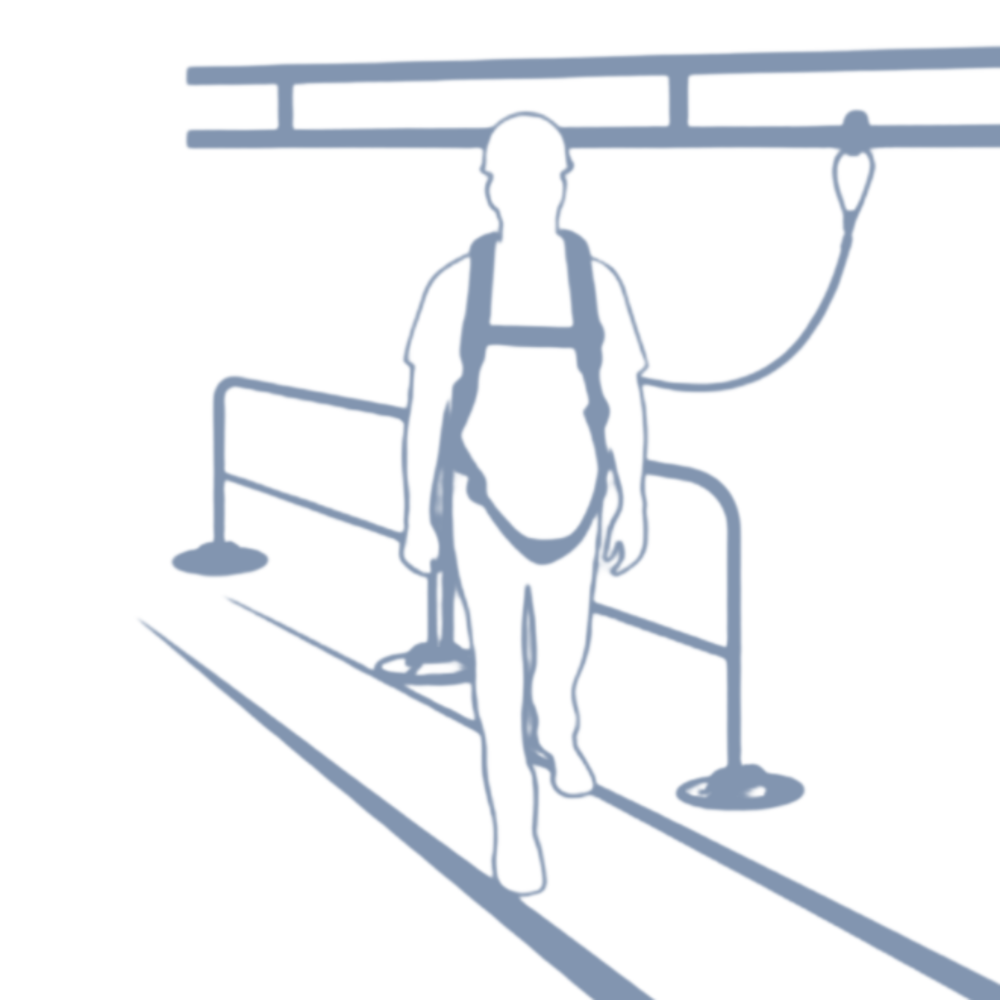
Facility managers need one plan for every trade that uses the roof, and roofing contractors need protection that is in place before the crew arrives.
- The whole access path covered: ladder, hatch, edge and work over the side, designed as one system
- Permanent or temporary: fixed systems for routine maintenance routes, relocatable rail for projects
- Anchor certification for building owners: a competent person pull tests or inspects each anchorage, and a qualified person verifies the results
- Engineered and stamped: EDGE calculates the loads and checks the roof structure, and a licensed professional engineer stamps the drawings after your approval
- Our own installation crews in all 50 states and Canada
- Ongoing support: annual inspections and five-year anchorage pull tests that keep your records current for the contractors who use your roof
Our Happy Clients
We are grateful for the wonderful testimonials from our happy and beloved clients. From local businesses owners to Fortune 500 executives. You all have helped make us a force in the workplace fall protection industry!
Building Maintenance Fall Protection FAQ
Facility managers, property managers and roofing contractors ask these questions first. Here are straight answers.
For routine maintenance under OSHA’s general industry rules, work less than 6 feet from a low-slope roof edge needs guardrail, a safety net, travel restraint or personal fall arrest. A warning line may mark a work area 6 to 15 feet back only for work that is infrequent and temporary, and at least 15 feet back for other work (29 CFR 1910.28(b)(13)). Re-roofing is generally construction and follows 29 CFR 1926.501(b)(10). See our guide: When is rooftop fall protection required? This is general information, not legal advice.
Before a rope descent system is used, the building owner must tell the employer in writing that each anchorage has been identified, tested, certified and maintained to support at least 5,000 pounds in any direction per employee, based on an annual inspection and certification at least every 10 years (29 CFR 1910.27(b)(1)). EDGE Fall Protection provides that certification: a competent person pull tests or inspects each anchorage, and a qualified person verifies the results.
Permanent guardrail fits edges along routine maintenance routes and equipment near the edge, because it protects every trade without anyone setting it up. Temporary guardrail fits a re-roof or a short project. The 360 Mobile Safety Rail can serve as either, because it sits on weighted bases and can be relocated. EDGE Fall Protection recommends based on who uses the roof and how often.
Because the exposure is constant. In FY2025, federal OSHA cited roofing contractors for fall protection violations (29 CFR 1926.501) in 86.5 of every 100 inspections, the highest rate of any construction trade, with framing close behind at 83.5. Fall protection has been OSHA’s most-cited standard for 15 consecutive years. These figures cover federal OSHA only, not State Plan states.