 Now Serving Canada
OSHA's 1910.28(b)(9)(i)(D): What the 2026 Fixed Ladder Cage Rule Change Means for You
Editor’s note: This article was written in March 2026 and is subject to updates.
OSHA’s 2017 compliance rule around ladder safety systems will no longer have a hard deadline of 2036. According to a memo published in September 2025, 1910.28(b)(9)(i)(D) may be withdrawn by a fast-tracked petition filed by major chemical and petroleum industry groups.
While this doesn’t necessarily affect the substance of OSHA’s general requirements, it does have the potential to extend the working life of existing ladders and fall protection equipment.
If you’re looking for a complete overview of OSHA’s fixed ladder standards, including physical construction requirements, CFR citations, and compliant system types, see our full guide to OSHA fixed ladder requirements. This article focuses specifically on what is changing with the fixed ladder cage requirement in 2026 and what contractors and safety managers should do next.
Article Summary
- OSHA’s 1910.28(b)(9)(i)(D) is likely going away, which removes the obligation to upgrade personal fall protection systems on fixed ladders over 24 feet.
- A 2025 petition asks OSHA to either allow cages permanently or grandfather existing ones. OSHA’s memo only confirms it’s removing the deadline, but hasn’t committed to either option.
- New ladders installed after November 2018 must still meet the new ladder safety standard: PFAs or fall systems for fixed ladders, and no cages or wells.
A Brief Timeline of OSHA’s Ladder Fall Protection Requirements
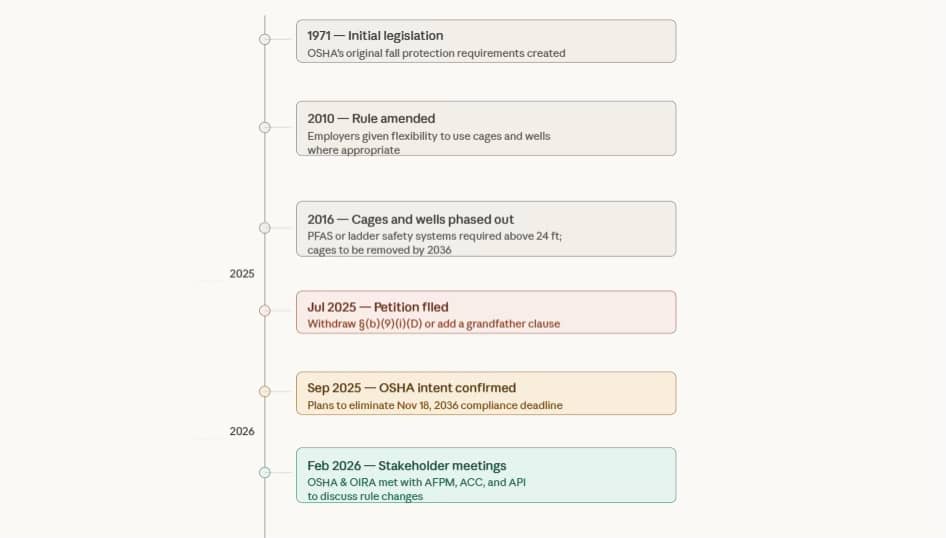
OSHA’s Subpart D for ‘Walking-Working Surfaces’ has seen four separate revisions since its inception in 1971. In that time, its guidance around ladders and fall protection requirements has changed significantly.
Here’s a short timeline of how the rules have evolved:
In May of 2010, OSHA amended its Walking-Working Surfaces and Personal Protective Equipment (Fall Protection Systems) rule to “allow employers the flexibility to install cages and wells that fit a particular situation, without compromising employee protection.”
However, the final ruling published in 2017 contained a new requirement that employers must exclusively use ladder safety systems or personal fall arrest systems with ladders above 24 feet. This eliminated the option to use cages or wells in any system, which dictated that they must be phased out by 2036.
The exact phrasing of 1910.28 B (9)(i)(D) is as follows:
“Final deadline. On and after November 18, 2036, all fixed ladders are equipped with a personal fall arrest system or a ladder safety system.”
But due to a petition filed in 2025, this rule may be eliminated entirely. This led to an announcement in September 2025 explaining that OSHA intended to withdraw 1910.28(b)(9)(i)(D) as a deregulatory action.
“OSHA rarely updates its standards, so when the 2016 ruling came out, it was a big change to what was being done in the workplace. The phase out of cages and wells was researched by OSHA, and the assessment was that it would save lives, reduce injuries, and limit operational downtime.” — Samantha Hansen, Marketing Manager @ EDGE Fall Protection
Why Did OSHA 1910.28 B (9)(i)(D) Get Changed?
Major oil and gas industry organizations, including the AFPM, ACC, API, and their members, took issue with 1910.28 B (9)(i)(D) and presented a petition in July 2025.
To summarize the argument made in the seven-page petition:
- OSHA alluded to the possibility of choice with its ladder safety options, then unexpectedly mandated the removal of existing cages and ladders with ‘outdated’ safety systems. As the petition argues: “OSHA did not solicit comments on whether cages provide effective fall protection, did not state that it was considering prohibiting cages, and did not provide a meaningful opportunity to develop evidence on that issue.”
- There is not enough evidence to support OSHA’s conclusion that personal fall systems are safer than ladder cages. In the petition’s exact words, “cages have advantages over ladder safety/personal fall arrest systems because they provide passive protection to all employees who climb ladders and do not depend on individual employees’ judgment, decision-making, and compliance with administrative requirements.”
- The process of reconfiguring, replacing, and/or retrofitting these older ladders may be more dangerous than simply leaving them alone. Petition constituents believe this work is more likely to result in injury than working from ladders equipped with existing cages. It will also be an extraordinary time sink: as much as 1,870,530 working hours just to meet OSHA’s requirement by the 2036 deadline.
- Beyond time considerations, compliance would also be expensive. For the petroleum industry alone, existing regulations would affect 22,000 ladders and cost more than $1.2 billion (likely $3 billion when extrapolated across the entire US refining industry).
- OSHA’s ladder safety/personal fall arrest system requirements are inconsistent with the current administration’s executive orders. Repealing, replacing, or amending it to provide a grandfather clause would, therefore, be a deregulatory action for the oil and natural gas industries.
“It’s difficult to apply general standards to all workplaces as each environment has its own variables and challenges. A particular challenge of implementing the ladder subpart D update is ensuring that the ladder, how it’s attached, and the structural integrity of the building are all adequately strong enough to resist the forces imposed on the various components in the event of a fall. We have to do a lot of engineering and sometimes field modification to ensure the field conditions can support one of our ladder PFAS.” — Michael McCarty, President @ EDGE Fall Protection
What Will Change About OSHA’s 1910.28 B (9)(i)(D) Requirement in 2026

The AFPM and ACC wanted OSHA to take one of two actions:
- Repeal the requirement that employers use personal fall arrest systems or ladder safety systems on all fixed ladders over 24 feet, which would allow cages and wells to remain as permanently acceptable fall protection options.
- Or a grandfather clause to 1910.28(b)(9)(i)(D) that allows ladders installed before the amended rule’s effective date to retain existing safety features indefinitely.
“The purpose of this memorandum is that OSHA is proposing to remove a provision, paragraph (b)(9)(i)(D), from 29 CFR 1910.28 (Docket No. OSHA-2025-0072). The provision to be removed sets a deadline (November 18, 2036) for the installation of personal fall arrest systems or ladder safety systems on all fixed ladders that extend more than 24 feet above a lower level.
OSHA anticipates this change will allow employers to update their ladders when the ladders reach the end of their service lives, accommodating the lengthy service life of fixed ladders, while significantly reducing costs and offering greater flexibility. This is a deregulatory action per Executive Order 14192, “Unleashing Prosperity Through Deregulation” (90 FR 9065, Feb. 6, 2025).”
After receiving the above petition, OSHA published the following memo in 2025:
Based on the September 2025 memo, OSHA plans to remove the rule’s provision paragraph (November 18, 2036) for the installation of personal fall arrest systems or ladder safety systems on all fixed ladders that extend more than 24 feet above a lower level.
OSHA anticipates this change will allow employers to update their ladders when the ladders reach the end of their service lives, accommodating the lengthy service life of fixed ladders, while significantly reducing costs and offering greater flexibility. This is a deregulatory action per Executive Order 14192, “Unleashing Prosperity Through Deregulation” (90 FR 9065, Feb. 6, 2025).
This information provides three points of interest:
- Removing the 2036 deadline does not eliminate OSHA’s underlying requirements. Fixed ladders above 24 feet still need fall protection. There is no guarantee that cages and wells will again be accepted as compliant options. They will likely only be permissible for existing installations.
- If OSHA does adopt a grandfather approach, ladders installed before the amended rule’s effective date may be allowed to retain cages or wells indefinitely. Ladders installed after the November 2018 deadline would still require a ladder safety system or PFAS.
- Nothing is set in stone (yet). While OSHA intends to remove its provision paragraph, this has not yet occurred. Safety managers should continue to monitor what OSHA requires and keep workers and employees informed of all changes.
For up-to-date guidance on this developing situation, follow EDGE Fall Protection on social media.
What Won’t Change with OSHA’s Fall Protection Standard
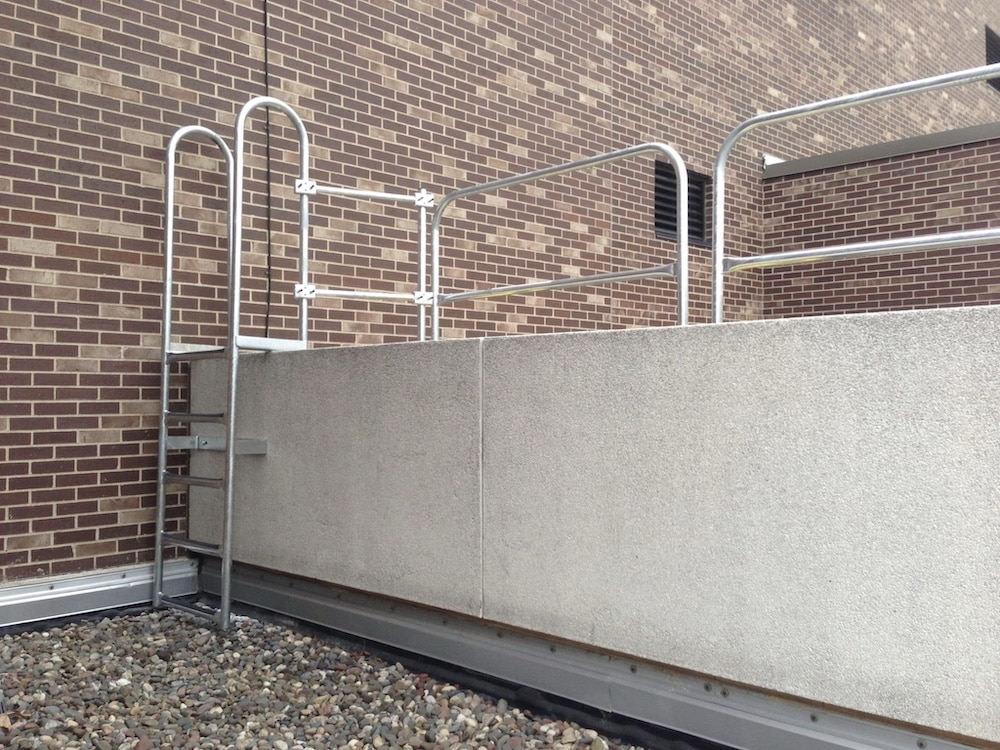
While the hard deadline for updating your ladders may be eliminated, OSHA still has significant requirements for any fixed ladder above 24 feet. Since ladder cages will not be viewed as a valid form of fall protection on ladders purchased after November 2018, you must still adopt a ladder safety system or personal fall arrest system for any new or replaced ladders.
The following list explains a few other considerations that are still required to maintain OSHA compliance with 1910.28 B. For a full breakdown of fixed ladder fall protection requirements under both 1910.28 and 1910.23, see our OSHA fixed ladder requirements guide.
- If you have a fixed ladder with a ladder cage that is longer than 50 feet, you must establish landing platforms at every 50-foot interval.
- All ladders must have specific physical requirements. For example, wooden ladders can’t have any coatings that hide structural defects, metal ladders must be designed with corrosion-resistant materials (or at least protected against corrosion), and portable ladders cannot be single-rail.
- Each fixed ladder installed before November 19, 2018 must have one of four safety features: a personal fall arrest system, a ladder safety system, a ladder cage, or a well. If you don’t currently own a ladder that meets these requirements, you may need to retrofit, upgrade, or purchase a new ladder.
“Change is difficult, but, overwhelmingly, the modifications brought by subpart D are rooted in safer workplaces and striving towards their original intent will help to keep workers safe.” — Cody Malepsy, Operations Manager @ EDGE Fall Protection
Keep in mind, this barely scratches the tip of the iceberg. There are many more general requirements for fixed ladder and fall protection systems, including the placement of guardrails and handrails, grab bars, ladder rungs, personal fall protection, safety nets, and rest platforms.
Or connect with one of our OSHA fall protection experts by calling EDGE Fall Protection at (844) 314-1374.
Frequently Asked Questions about OSHA’s Ladder Fall Protection Requirements
Q: Is OSHA getting rid of 1910.28(b)(9)(i)(D)?
Yes, OSHA will likely eliminate rule 1910.28(b)(9)(i)(D), which states that “on and after November 18, 2036, all fixed ladders are equipped with a personal fall arrest system or a ladder safety system.”
But it still expects that “all fixed ladders are equipped with a personal fall arrest system or a ladder safety system” whenever a fixed ladder reaches the end of its service life. Time will tell whether cages or wells are ‘grandfathered’ in, which would allow the continued use of those specific fall protection systems.
Q: Which ladders require fall protection according to OSHA?
OSHA regulations state that a personal fall arrest system is required for fixed ladders over 24 feet.
You should know that fall protection is not required for employees who are working or climbing on portable ladders.
Q: What does OSHA consider a personal fall protection system?
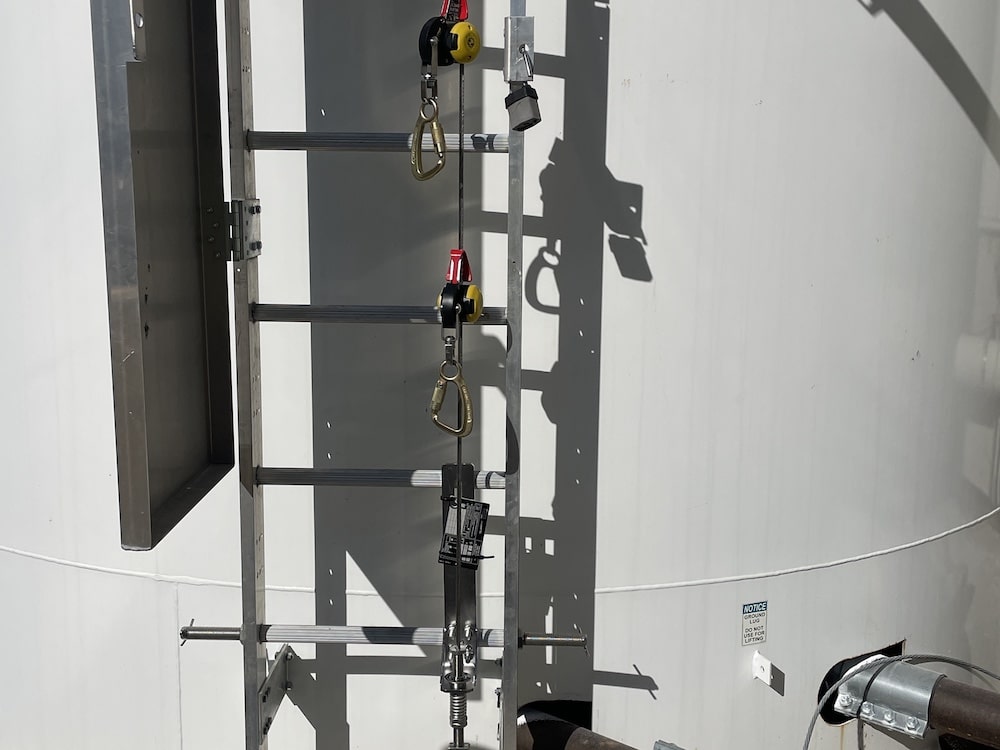
There are two different types of personal fall protection systems: a personal fall arrest system (PFAS), or a ladder safety system. A personal fall arrest system is a full-body harness that connects a worker to an anchor point via a lanyard or self-retracting lifeline (SRL). A ladder safety system is a sleeve that travels alongside a fixed ladder via a vertical rail or cable.
Here’s a visual breakdown of what these two look like:
| PFAS | Ladder Safety System | |
|---|---|---|
| Where it's anchored | Separate anchor point | The ladder itself |
| Worker action required | Must connect lanyard before climbing | Sleeve travels automatically |
| Hardware | Harness + SRL or lanyard | Cable / rail + grab sleeve |
Q: Why is OSHA getting rid of 1910.28(b)(9)(i)(D)?
As argued by a 2025 petition, OSHA’s updated ladder standard did not provide enough time for employers to comply in a timely, cost-effective manner. It will require multiple years, as well as millions of dollars, to retrofit or replace ladders. This process will also expose workers to additional hazards, which defeats the purpose of the safety standard.
Q: Can I keep ladders with cages or well systems?
A 2010 OSHA ruling told safety managers they must have one of four safety features attached to a ladder: ladder cages, ladder walls, ladder safety systems, or personal fall protection systems.
But 2017’s addition to 1910.28(b)(9)(i)(D) eliminated ladder cages and ladder wells from the list of options. These options were to be completely phased out from existing and new ladders beginning in 2036.
Due to a petition in 2025, cages and wells may be acceptable for older or preexisting ladders. But keep in mind that cage and well systems may or may not be grandfathered into the 1910.28(b) rules in 2026.