 Now Serving Canada
Active Fall Arrest

Free Standing Swing Arm
A rotating overhead anchor on a freestanding base — coverage across a work area with no building modification.

Column Fold Away
A column-mounted arm that folds flat against the column when not in use, using zero floor space.

Freestanding Cantilever Rigid Rail
Continuous overhead protection along a full work line, on a counterweighted base with no building attachment.

Ceiling Mounted Rigid Rail
Continuous overhead protection suspended from the building structure, with zero floor footprint.

Portable & Mobile Fall Arrest System
A rated overhead anchor on wheels — rolls to the work, sets up in minutes, no installation required.

Ladder Fall Arrest System
A cable or rail with a locking sleeve that satisfies the fixed ladder requirement a cage no longer meets.

Horizontal Lifeline System
Continuous tie-off across long spans, engineered to your structure, span, and simultaneous user count.
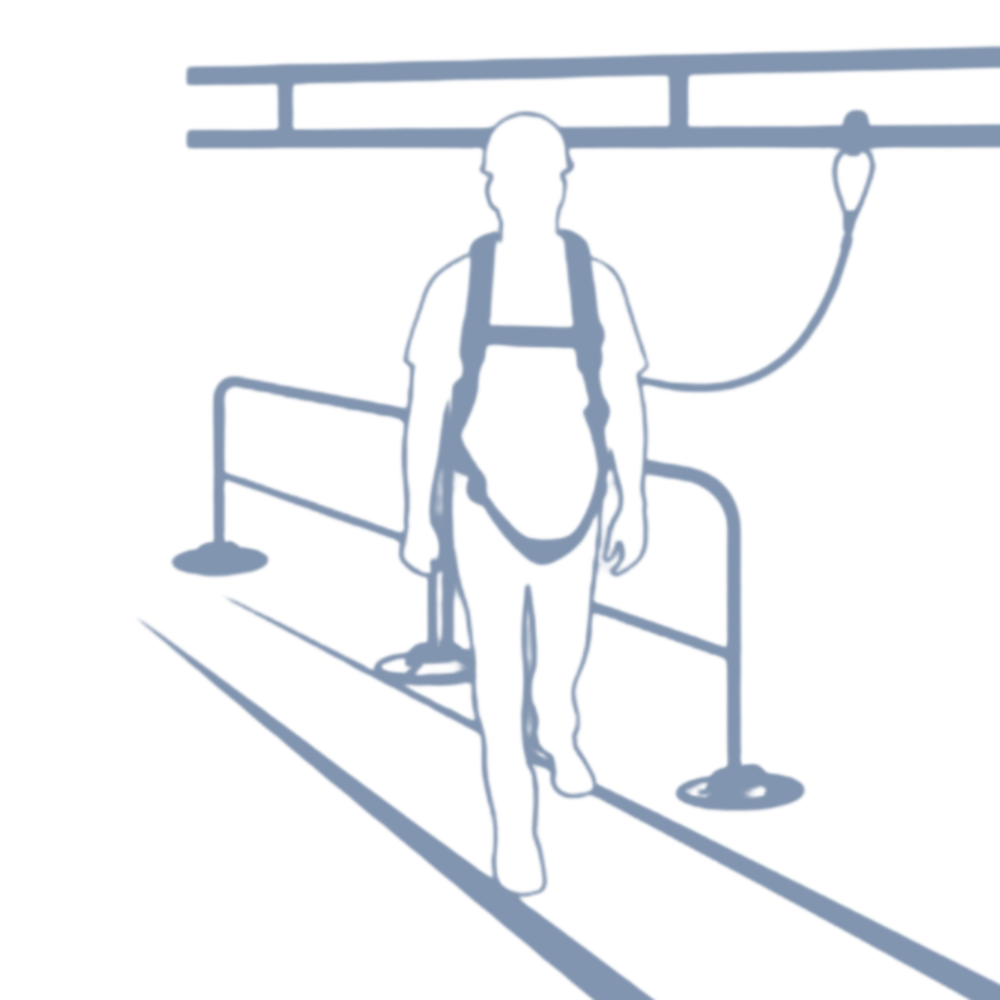
Fall Arrest, Fall Restraint, Fall Prevention
Three terms that get used interchangeably and should not be.
- Fall prevention is passive. Guardrail, screens, and barriers stop a fall from being possible. No training, no PPE, no user decision.
- Fall restraint ties the worker to an anchor with a lanyard short enough that reaching the edge is impossible. The fall never starts.
- Fall arrest catches a worker after the fall begins, and must account for free-fall distance, deceleration, harness stretch, and the clearance to the surface below.
The hierarchy of controls prefers prevention, then restraint, then arrest. We lead with passive guardrail wherever it fits and reserve active systems for the work that genuinely happens beyond it.
Active Fall Arrest FAQ
What EHS managers need to settle before specifying a lifeline, rigid rail, or anchor system.
Fall clearance is the vertical distance a system needs to stop a worker before they strike the surface below. It adds up free-fall distance, deceleration distance as the energy absorber deploys, harness stretch, and a safety margin. If the available clearance is less than the system requires, the worker is arrested after impact, which defeats the purpose. Clearance is calculated for every system we design.
Sometimes, but never on assumption. OSHA requires anchorages for personal fall arrest to support 5,000 lb per attached worker, or be designed with a safety factor of at least two under the supervision of a qualified person. Existing steel may or may not carry that once the connection detail is considered. We evaluate the structure and produce stamped calculations rather than clamping onto a convenient beam.
Then a freestanding system is the answer. Counterweighted cantilever rigid rail, portable and mobile fall arrest units, and freestanding swing arms all provide a rated anchor without touching the structure. They suit leased buildings, historic structures, and operations that need to relocate the anchor point between work areas.
Only as many as the system was engineered for, and that number is fixed at design time. Each additional user increases the load on the anchors and the sag in the line, which in turn increases required fall clearance. Tell us the maximum simultaneous users during the quote. Adding a worker to a system rated for fewer is a serious and surprisingly common violation.
At least annually by a competent person, and certified anchorages need pull testing at least every five years. Any component involved in an actual fall comes out of service immediately. Our in-house inspection department performs both and delivers a documentation package with photos, measurements, and test results for your compliance file.