 Now Serving Canada
Industrial Safety Gates

EDGE E3 Industrial Safety Gate
Our flagship self-closing gate — adjustable across a range of widths and rated to the same load case as guardrail.

Loading Dock Gate
Barrier protection for an open dock door, so the four-foot drop is guarded whenever a trailer is not in the bay.

Horizontal Mezzanine Safety Gate
A pivoting dual-gate system that always leaves one side of the mezzanine opening protected — with no overhead clearance required.

Vertical Mezzanine Safety Gate
A lift gate that rises clear of the opening, keeping the deck completely free for direct forklift placement.

Pallet Flow Safety Gate
Protection for elevated pallet drop zones on racking, guarded between deliveries and open only when the lift truck is there.

Self-Closing Ladder Safety Gate
A spring-loaded gate at the top of a fixed ladder that closes behind the climber automatically.
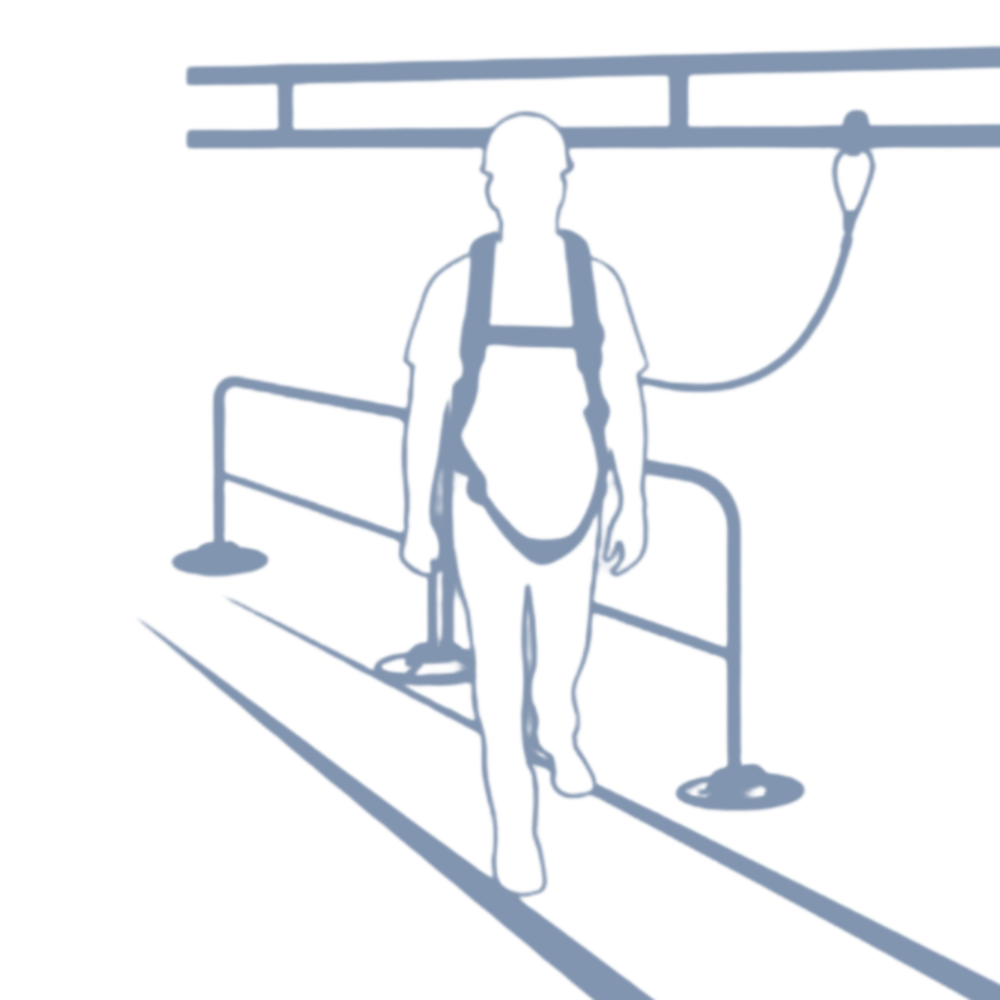
Openings That Need a Gate
- Loading dock doors left open for ventilation or between trailers
- Mezzanine and platform edges where product is staged or lifted through
- Ladder landings and roof hatches, where a worker steps out backward into open space
- Pallet drop zones on elevated racking, protected while the forklift is away
- Conveyor and machine access points that open onto a drop
Pair gates with permanent rail systems along the surrounding edge and the whole level reaches compliance in one project.
Industrial Safety Gate FAQ
What facility managers ask before specifying gates for docks, mezzanines, and ladder access points.
Not as equivalent protection. OSHA 29 CFR 1910.29 requires a guardrail system to withstand 200 lb applied in any downward or outward direction, and a chain cannot meet that. Chains also fail the practical test: they get unhooked and left hanging. A self-closing gate is the accepted solution because it restores protection automatically and holds the required load.
Away from the hazard, always. A gate at a ladder landing or mezzanine edge should swing back toward the safe walking surface, never out over the drop. Swinging outward means a worker leaning on it is pushing into open space. Our gates ship configured for the correct swing based on the opening you describe, and the direction is confirmed on the shop drawing before fabrication.
Several of our gates are adjustable across a range of widths, which covers most real-world openings without custom work. Beyond that range we fabricate to your dimension. Send the clear opening width, the mounting surface, and a photo with your quote request, and we will confirm whether an adjustable model fits or a custom build is the better answer.
It depends on your overhead clearance and how material moves. A horizontal gate pivots in the plane of the floor and suits areas with low ceilings or overhead obstructions. A vertical lift gate rises and needs headroom, but keeps the deck clear and works well where a forklift places pallets directly into the opening. We will recommend one after seeing the clearance and the loading method.
They should be part of your regular fall protection inspection program. Hinges wear, springs weaken, and mounting hardware loosens under daily traffic, all of which can stop a gate from fully self-closing. Our inspection department checks gate operation alongside guardrail, anchors, and lifelines, and documents findings in one report.